5 Best NoteGPT Alternatives in 2026
Sanduni
Growth Content Editor

I understand you're looking for NoteGPT alternatives because you need notes from live meetings, not just YouTube videos.
Or you may need a way to share summaries with teammates, or notes from those "quick Zooms" that somehow become 47 minutes!
We covered five tools here, from bot-free meeting capture to searchable knowledge bases to transcript-based video editing.
Why are people searching for NoteGPT alternatives?
1. You need notes from actual meetings, not just YouTube videos
NoteGPT's official FAQ states it clearly:
"Currently, NoteGPT does not support you to make notes during video conferences."
NoteGPT is good at what it does.
Summarising a 3-hour lecture into digestible notes? Solid.
Breaking down a dense research paper? Actually useful.
But there's an entire category of note-taking it doesn't touch: live meetings.
The daily standups.
The client calls.
The "let me just hop on a quick Zoom" that somehow becomes 47 minutes.
If you're a student using NoteGPT for recorded lectures, you're probably fine. If you're a professional whose day is 60% meetings... you're looking at two separate tools. One for your YouTube learning, another for your actual job.
Jamie records directly from your device microphone during live calls, Zoom, Google Meet, Teams, whatever and wherever you are, because we support iOS too.
When someone detects you've joined a video call, it asks if you want to start recording. No bot joining the meeting. No awkward "Jamie is now recording" announcements.
2. You want to share notes with your team (not just yourself)
Again, straight from NoteGPT's FAQ:
"Currently, NoteGPT does not support collaboration with other users."
This is an interesting design choice. NoteGPT positions itself as a personal learning tool, which makes sense for students grinding through course material solo. Your notes are your notes.
But what happens when you're in a team?
When your colleague misses the meeting and needs the summary?
When your manager wants to see the action items from that client call?
You're... copying and pasting into Slack? Exporting to a doc? Emailing yourself??
We built Jamie with team sharing baked in. You can email summaries directly to anyone (even people without Jamie accounts). On Team plans, you share full meetings with workspace members; they see it in their "Shared with me" section.
Or just create a public link if someone needs quick access.
What are the best NoteGPT alternatives?
The best NoteGPT alternatives are Jamie with its bot-free live meeting capture and built-in team sharing, Recall, and Eightify.
We put together a quick comparison of all five tools below.
💜 Gentle Reminder: Pricing may change; please double-check on each tool's official site. Plans evolve, and enterprise tiers often require a quick chat with sales for accurate quotes.
Jamie
Best for: Live meeting notes without bots, with speaker identification and GDPR compliance
Similar to: Otter.ai, Fireflies.ai, Tactiq, Notta
💜 Try out Jamie in our hands-on demo and see how easy (and fun!) note-taking can be!
Jamie records your meetings directly from your device's microphone and system audio, which means no bot ever joins your call. It listens while you talk and gives you summaries, transcripts, and action items the moment you stop recording.
We support 100+ languages for transcription and summaries, and we genuinely get excited when users tell us their multilingual meetings came out clear. You can also chat with your notes afterwards to pull out specific details or draft follow-up emails.
Whether you run your meetings on Zoom, Teams, Meet, or entirely in person, Jamie works everywhere. If you need something that handles live conversations (and not just pre-recorded files), this might be what you're looking for.
Who is it for?
Professionals who want detailed meeting notes without the awkwardness of a bot sitting in their call, and anyone tired of choosing between paying attention and taking notes.
Key features
Records live meetings from your device without a bot joining as participant
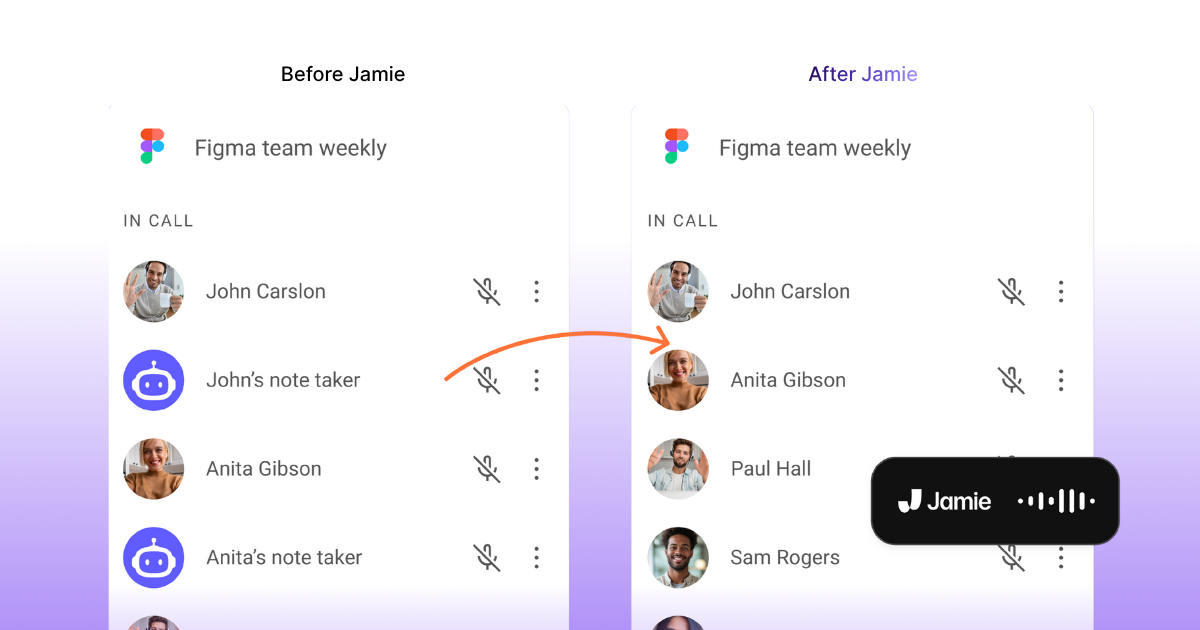
Jamie captures live audio directly from your microphone and your system audio, so it knows when a meeting is happening without ever appearing on your participant list.
It detects audio activity on your device (or nudges you via calendar sync a minute before) and that's how it figures out you're in a call. You still inform participants that you're recording, either by saying so at the start or through Jamie's auto-email feature that sends a heads-up 24 hours beforehand.
We're also on iOS, so you can take Jamie to in-person meetings too (truly anywhere, that one wasn't marketing fluff).
Live Recorder: Captures audio directly from your device during Zoom, Teams, Meet, and all other calls automatically.
AI Summary: Generates structured meeting notes covering key points and main topics discussed immediately after recording.
Speaker Identification: Learns voices over time and labels who said what throughout your transcripts automatically.
Scratchpad: A private notepad during recordings where you can jot down thoughts without anyone else seeing them.
Full Transcript: Every word spoken gets transcribed with timestamps so you can reference exact conversations anytime needed.
Mobile App: Records in-person meetings from your iOS device and syncs everything to your desktop automatically and instantly.
Chat with your notes and search across all your meetings easily
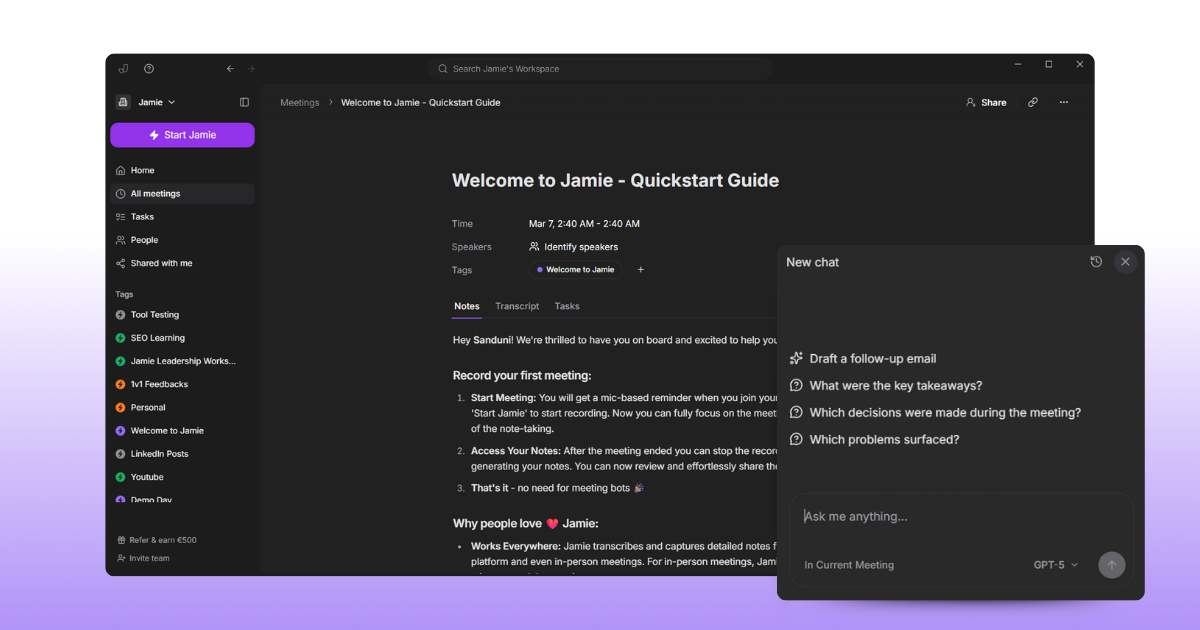
After Jamie generates your notes, you can actually have a conversation with them. Ask questions about what was discussed, pull out specific details, or let the draft follow-up emails be based on the meeting content. The Ask AI feature works within a single meeting (to get very specific answers) or across all your meetings (when you can't remember which call mentioned that one thing).
Ask AI Single Meeting: Query one meeting's transcript and summary to get precise answers about what was said.
Ask AI All Meetings: Search across your entire meeting history to find patterns, references, or that forgotten detail.
Keyword Search: Enter any word in the sidebar and find every meeting where that topic came up quickly.
Tags for Organisation: Create private or shared tags to group meetings by project, client, or team for easy filtering.
Customise how your summaries look with flexible templates you control
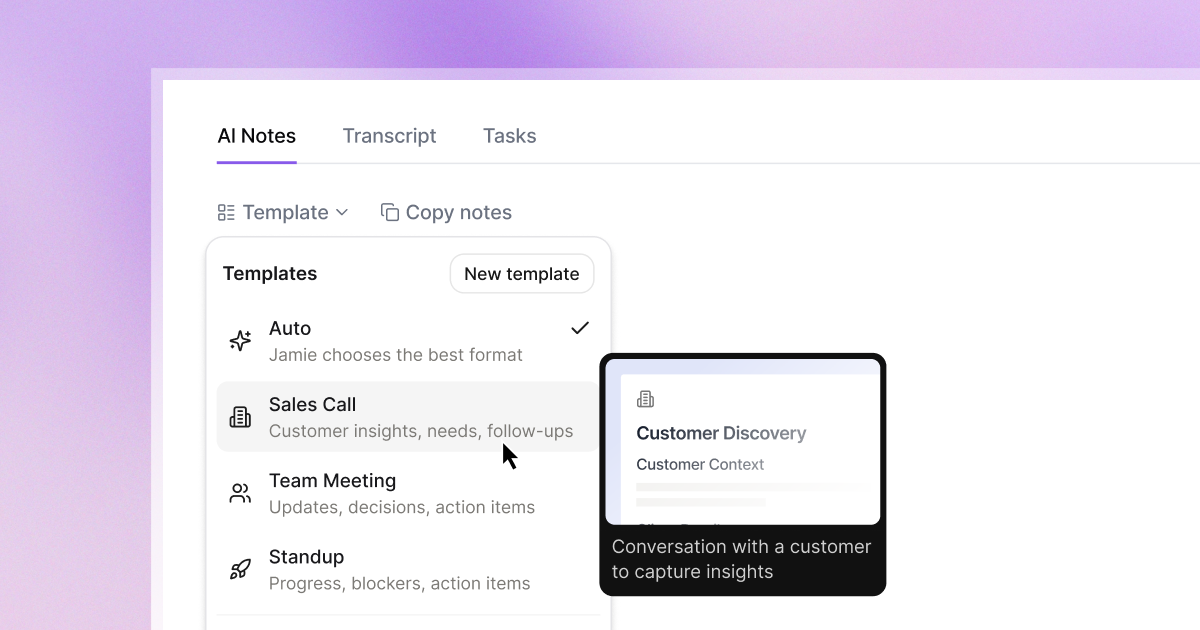
I know the default summary format might not be what you need for every meeting. Sales calls need different structure than team standups, and interviews are their own thing entirely. Jamie lets you create templates that tell it exactly what sections to include and what information matters most to you.
Custom Templates: Build your own summary structure with specific sections and instructions for exactly what you need.
Auto-Apply Templates: Let Jamie automatically pick the right template based on meeting content and calendar context.
Default Templates: Start with pre-built formats for common meeting types and customise them to match your workflow.
Detail Levels: Choose between extensive or brief summaries depending on how much context you want each time.
Send your notes to your CRM, Notion, or wherever your team actually works
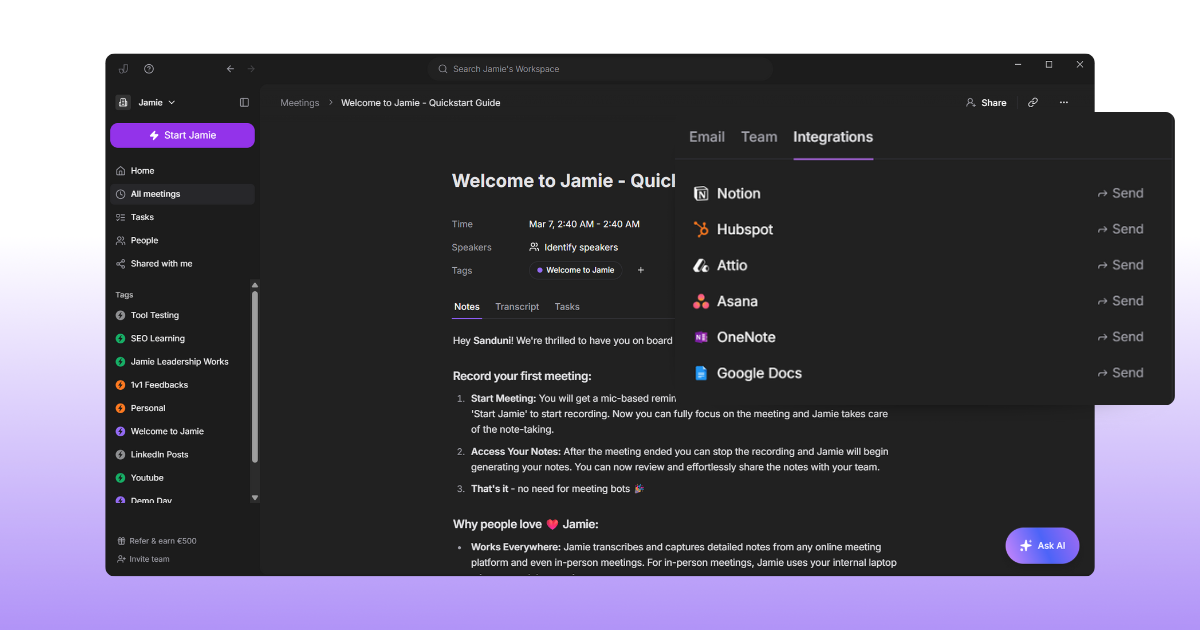
Meeting notes locked in one app rarely help anyone. Jamie connects to the tools you already use so your notes flow into your existing workflow without copy-pasting or switching tabs constantly.
HubSpot Integration: Log meeting notes directly to contacts, companies, and deals so your CRM stays updated automatically.
Salesforce Integration: Attach notes to opportunities, accounts, and contacts without leaving your current sales workflow at all.
Notion Integration: Create Notion pages with your summaries and transcripts so everything lives in your knowledge base.
Google Docs Export: Send meeting content to Google Docs for editing and collaboration with teammates who prefer it.
Team Sharing: Share full meetings with workspace members or send email summaries to anyone, even without Jamie accounts.
Your data stays in Germany, encrypted, and never used for training models
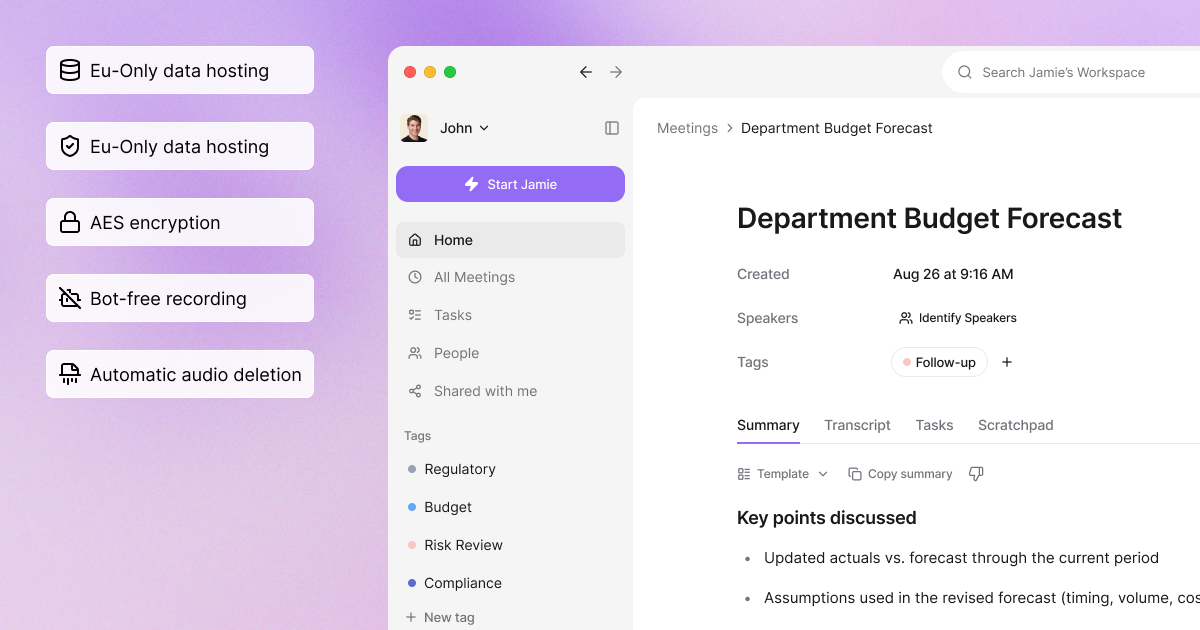
We know meeting conversations can include sensitive information, and we take that seriously. Jamie is based in Germany and complies with GDPR, which means strict data protection rules apply to everything we do with your recordings.
EU Data Residency: All data is stored on servers located in Germany with full GDPR compliance and encryption.
Audio Deletion: Jamie permanently deletes all audio files after processing, only keeping the text transcript you need.
No Training Use: Your meeting data is never used to train AI models; it stays connected only to your account.
Consent Features: Inform participants via manual announcement or auto-email notification sent 24 hours before meetings start.
Pricing
Personal Plans:
Free: €0/month (0 meetings/month, 30-min max duration, 20 AI messages/day)
Plus: €25/month (20 meetings/month, 2-hour max duration, 40 AI messages/day)
Pro: €47/month (Unlimited meetings, 3-hour max duration, 100 AI messages/day)
Business Plans:
Team (2+ users): €39/seat/month (Unlimited meetings, centralised billing, encryption)
Enterprise (10+ users): Custom pricing (SSO, admin controls, EU data residency, DPAs, volume discounts)
Annual billing offers 17% discount. Source: Jamie Pricing Page
Pros and cons
Pros
Stood out as the best option after testing a dozen AI meeting tools
"I tried a dozen AI tools for meeting note taking. Most of them were crap, except one: Jamie" - G2
Transcribes and detects action items with more accuracy than others
"After researching and downloading different tools to generate meeting summaries, I decided to keep only this one. Why? Because it can transcribe, summarize, and detect action items with way more accuracy than the rest." - G2
Simple standalone tool that works without joining video calls at all
"I really appreciate Jamie for its simplicity and standalone functionality. It's incredibly easy to use without the need to join conferencing meetings or video calls." - MakeUseOf
Records meetings without a bot appearing as a visible participant
"Jamie is the first tool I've tried that doesn't require a bot. It captures your notes without appearing as a meeting guest, handles both online and offline conversations." - LinkedIn (Tim Schumacher)
Handles multilingual meetings surprisingly well including Japanese
"Saved me a lot of time. Surprisingly also performed well in meetings with multiple languages (Japanese and English) used." - Product Hunt (Julia Hollnagel)
Cons
Ask AI feature and integrations could still use some improvement
"I think overall the Ask AI feature can still be improved a little bit and the amount of integrations." - G2
Speaker identification works better with a good quality microphone
"The speaker identification feature of Jamie, though very useful, isn't entirely reliable or infallible. In our experience, to get the most effective results from Jamie, it was necessary to invest in a good quality microphone." - G2
Some buggy things and missing integrations but improving quickly
"There are a few buggy things and missing integrations but Jamie is young and I have full confidence in what their future looks like. It's better than every other app I've tried." - G2
Note generation can take several minutes which may feel slow
"Slow Note Generation: Processing can take several minutes, which may delay access to critical information in real time." - G2
Audio quality from your side heavily impacts the transcription
"Jamie's features are outstanding, sometimes I had the feeling that my audio quality heavily impacts the outcomes, which I need to adapt from my side." - G2
Recall
Best for: Building a second brain from YouTube, articles, and podcasts
Similar to: Notion, Readwise, Mem, Roam Research, Obsidian, Fabric
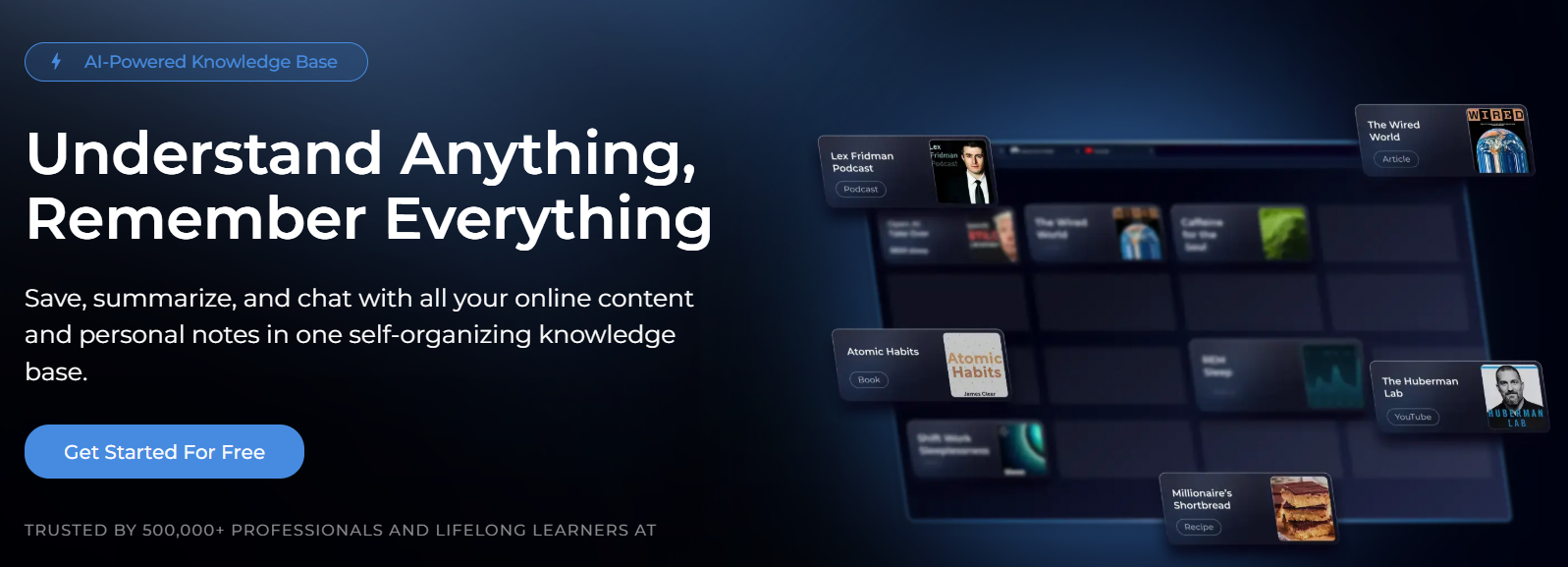
Recall summarises YouTube videos, podcasts, articles, and PDFs, and I find it genuinely useful for capturing ideas before they disappear. Everything you save gets automatically tagged and linked in a knowledge graph (a visual map that connects your ideas), making it surprisingly easy to find things later.
There are also spaced repetition quizzes that help you actually remember what you saved, which is something I didn't know I needed until I tried it! You can chat with your entire knowledge base at once, asking questions across everything you've ever saved.
Students, researchers, and lifelong learners might find this especially useful for building a personal library that grows smarter over time.
Who is it for?
People who consume a lot of online content and want to actually retain and connect what they learn, rather than just bookmarking things they'll never revisit.
Key features
One-click summaries: Summarise YouTube, podcasts, and PDFs in seconds.
Knowledge graph: Ideas link automatically, so you find connections.
Spaced repetition: AI quizzes help you remember what you saved.
Chat with knowledge: Ask questions across your entire library.
Auto-tagging: Content gets organised without any manual effort.
Pricing
Lite: Free (10 AI summaries, unlimited read-it-later)
Plus: $10/month ($7/month billed annually)
Business: Custom pricing
Source: Recall Pricing
Pros and cons
Pros
Saves hours by summarising YouTube videos before you commit to watching
"I create a short summary first just to judge if a two-hour video deserves a full watch" - Firefox Add-ons
Organises everything automatically with AI tagging and card system
"Everything gets saved in cards, automatically tagged with AI, and it's very easy to get back to it" - Firefox Add-ons
Works well as a complete knowledge base for students and learners
"Vital for students, teachers, and the lifelong learners that make up the rest of us" - Google Play
One-click summaries let you decide if content is worth your time
"With just one click, I get a clean, structured summary that lets me decide: Is this really worth my time?" - Firefox Add-ons
Application is fantastic and worth the subscription for power users
"The application is fantastic worth the subscription" - Firefox Add-ons
Cons
Adding content can feel clunky and the interface takes time to learn
"Adding content is clunky and the UI is not intuitive for something that's supposed to help act as a second brain" - Google Play
Free plan limits you to ten AI summaries which some find restrictive
"Once you reach 10, you are unable to create any more; even if you remove some, the app will still prompt you to upgrade" - Firefox Add-ons
Performance has slowed down noticeably with recent feature additions
"The extension has taken a huge performance hit with all the new features and has made it almost unusable for me" - Firefox Add-ons
Pocket imports only work for paid users which caught some off guard
"On the free plan only first 10 of your Pocket bookmarks will be imported" - Firefox Add-ons
Some users report occasional bugs with widgets and verification loops
"Pinned widget does not work, asks to confirm already confirmed email, infinite loop" - Firefox Add-ons
Eightify
Best for: Quick YouTube summaries when you just want the key points
Similar to: NoteGPT, Summarify, YouTube Summary with ChatGPT, Glasp, Snipd
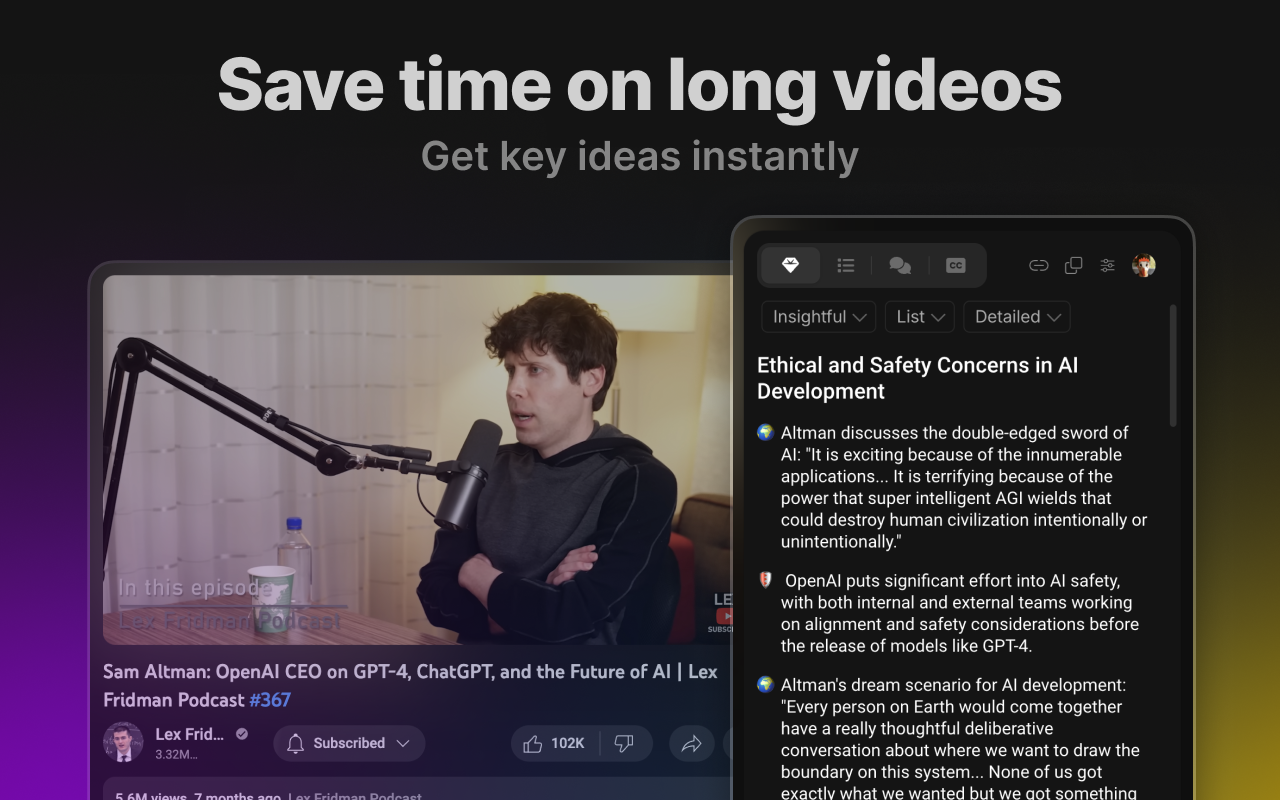
With Eightify, you get YouTube video summaries in seconds, and I appreciate how it helps you decide if a two-hour podcast is actually worth your time. The browser extension sits right on YouTube and gives you key insights, timestamps, and even a cleaned-up transcript.
You can customise what kind of insights you want (actionable, controversial, funny) and choose short, medium, or detailed summaries depending on your mood.
It supports 40+ languages for both summaries and translations, and works across Chrome, Safari, iOS, and Android with one account. The focus is purely on YouTube videos, and it does that one thing really well.
Who is it for?
People who watch a lot of YouTube content and want a quick way to screen videos before committing, or grab the key points without sitting through the whole thing.
Key features
Instant summaries: Get key points from any YouTube video in seconds.
Timestamped navigation: Jump to specific moments without scrubbing.
Customisable insights: Choose an actionable, controversial, or funny focus.
Better transcripts: Cleaner text than YouTube's auto-generated captions.
40+ languages: Summaries and translations work across the globe.
Pricing
Free trial: 7 days (unlimited summaries during trial)
Pro Monthly: $9.99/month
Pro Annual: $4.99/month (billed annually at $59.99)
Source: App Store
Pros and cons
Pros
Summaries help you decide if lengthy videos are worth watching
"It allows me to read the summary of the video before watching it; it's like reading the Paper Abstract before deciding if the paper is for me" - Eightify
Works directly in YouTube so you don't have to switch tabs
"It's super convenient that you can get a summary of a video with one click" - Eightify
Transcripts are cleaner and more accurate than YouTube captions
"The transcription was pretty accurate; every sound of the presenter was included with minimal mistakes" - Siteefy
Timestamps let you jump straight to the parts that matter
"Summaries include timestamps that help locate specific parts of videos easily" - Chrome-stats
One account works across browser, phone, and tablet devices
"One account, unlimited devices: Use on Chrome, iOS, and Android" - Chrome Web Store
Cons
No free tier after trial so you must pay to keep using it
"No free plan, but the Pro plan includes a 3-day free trial to explore features before subscribing" - Siteefy
Only works with YouTube videos so other content is excluded
"Only supports YouTube videos, limiting source variety" - Siteefy
Dark mode still missing which causes eye strain for some users
"Dark mode not available and the app has too bright of a background that my eyes start burning" - App Store
Non-English videos sometimes only produce English summaries
"Non-English videos may be summarized only in English, reducing usefulness for non-English users" - Chrome-stats
Some users report billing issues when trying to cancel plans
"I cancelled the subscription 3 times and it kept coming back under subscriptions" - App Store
NotebookLM
Best for: Turning documents into podcast-style discussions you can listen to
Similar to: ChatGPT, Perplexity, Notion AI, Obsidian, Roam Research
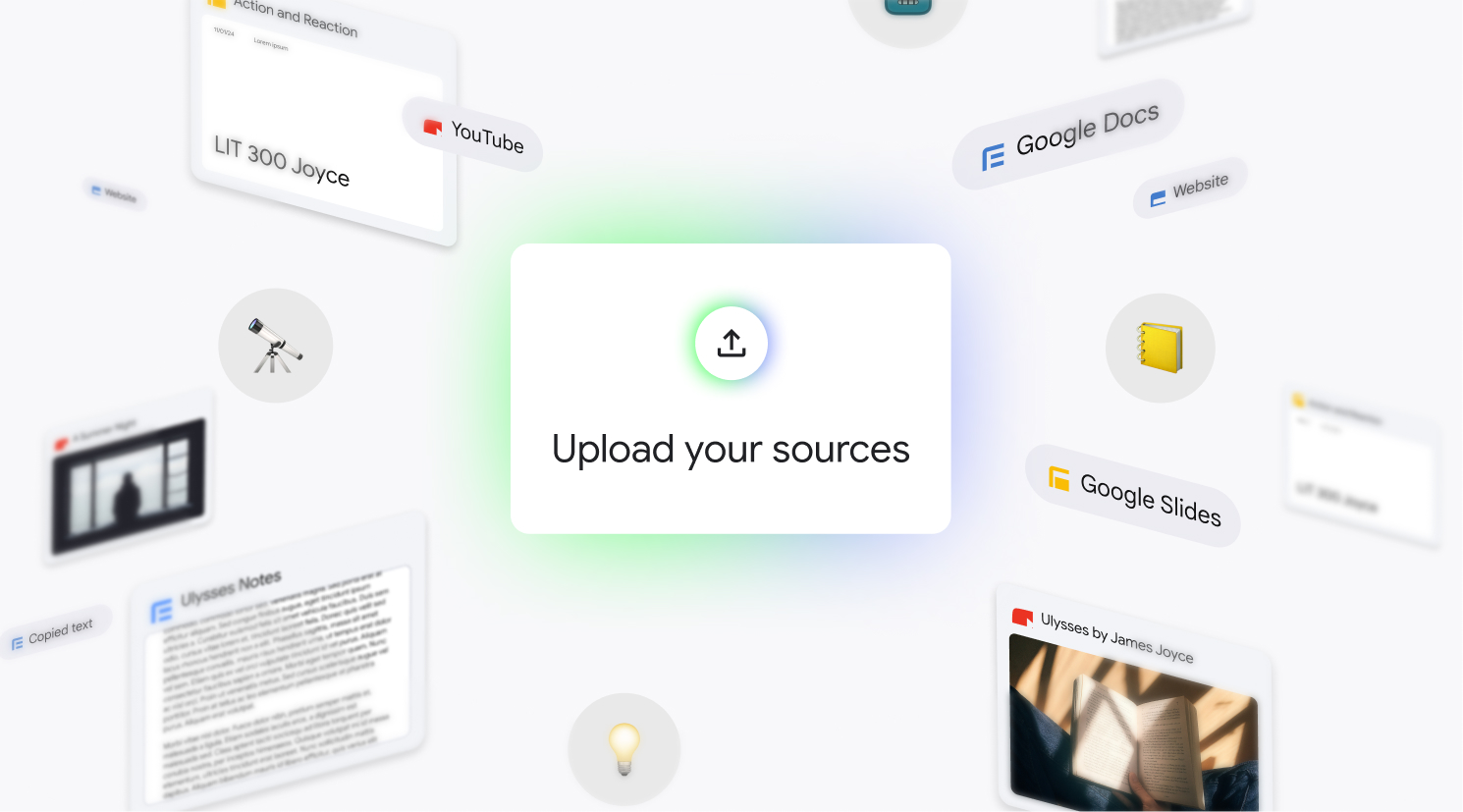
NotebookLM only answers from the documents you upload, which means no random hallucinations from the internet, and I genuinely trust its citations. The standout feature is Audio Overviews, where two AI hosts discuss your content in a podcast format that somehow makes dense research feel approachable!
Upload PDFs, Google Docs, YouTube videos, websites, and audio files, then ask questions and get answers with inline citations linking back to your sources. Google has kept the free tier surprisingly generous with 100 notebooks, 50 sources each, and 50 daily queries.
Processing complex documents becomes genuinely easier when your AI assistant only speaks from what you've given it.
Who is it for?
Researchers, students, and professionals who need to digest large amounts of content and want an AI that stays grounded in their actual sources rather than making things up.
Key features
Audio Overviews: Two AI hosts turn your documents into podcasts.
Source-grounded answers: Only uses what you upload, with citations.
Multi-format uploads: PDFs, Docs, YouTube, websites, audio files.
Study tools: Auto-generates flashcards, quizzes, and study guides.
Mind maps: Visualises connections between ideas in your sources.
Pricing
Free: 100 notebooks, 50 sources each, 50 daily queries, 3 audio overviews/day
Plus (via Google One AI Premium): $19.99/month (500 notebooks, 300 sources, 500 queries, 20 audio overviews/day)
Student discount (US): $9.99/month for 12 months
Source: Google One AI Plans
Pros and cons
Pros
Only uses your sources so answers are trustworthy with citations
"NotebookLM is designed to answer questions based on the information provided in your uploaded sources" - Google Support
Audio Overviews turn documents into podcasts you can listen to
"When I heard the two AI hosts talking about the sources I uploaded, I felt like Google's AI tool crossed a line" - TheBusinessDive
Handles massive amounts of text far beyond most competing tools
"Impressive capacity to process significant amounts of text, up to 25 million words across 50 sources, a major advantage over other tools" - Toksta
Free tier is genuinely useful without forcing you to upgrade
"NotebookLM's free version features are already very comprehensive" - CloudInsight
Saves notes and insights directly so you can reference them later
"It's super easy to use. Just click the pin icon at the end of any output to save it as a note" - Steal These Thoughts
Cons
No export feature so getting content out is frustratingly manual
"There's no export. You can copy-paste individual responses, but citations don't transfer as links. The formatting breaks." - XDA Developers
Notebooks are siloed with no cross-referencing between projects
"Notebooks can't talk to each other. If you've uploaded overlapping sources, NotebookLM won't surface those connections." - XDA Developers
Sometimes misses nuances in complex documents and needs checking
"It's still susceptible to inaccuracies, demanding careful verification. The potential for bias towards larger documents is also a concern." - Toksta
Usage limits on free tier can be hit quickly by heavy researchers
"Some users hit usage limits quickly, leading to frustration, and the perceived monthly cost after the free trial is a concern for heavy users" - Toksta
Only answers from your sources so it cannot search the wider web
"This means that you may sometimes not get an answer to a research question" - Effortless Academic
Descript
Best for: Editing video by editing text, like editing a document
Similar to: Adobe Premiere Pro, Final Cut Pro, Riverside, ScreenFlow, Camtasia
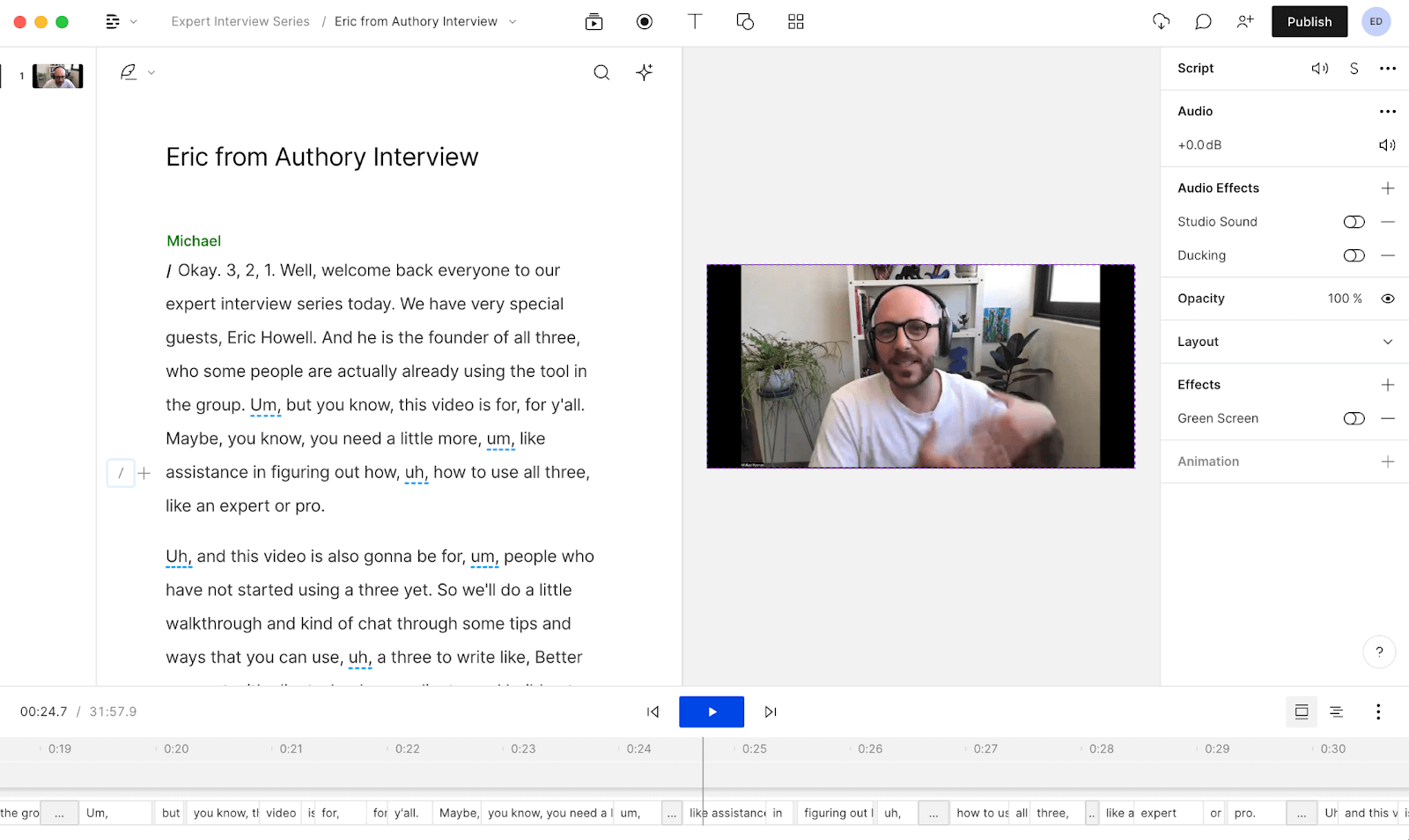
Descript lets you edit video and audio by editing the transcript instead of wrestling with a timeline, and I find that approach genuinely refreshing.
Delete a word from the text and it vanishes from your recording, rearrange sentences and the video follows, which feels almost like magic!
The AI handles tedious cleanup too, removing filler words, enhancing audio quality, and even cloning your voice so you can fix mistakes without re-recording. Podcasters and video creators have gravitated toward it because the learning curve is gentle compared to traditional editors like Premiere or Final Cut.
Whether you're making training videos, podcasts, or social clips, this tool makes the whole process feel less like work.
Who is it for?
Podcasters, YouTubers, marketers, and anyone who creates video or audio content but finds traditional timeline-based editors overwhelming or time-consuming.
Key features
Text-based editing: Edit video by editing the transcript directly.
Filler word removal: AI finds and cuts ums, uhs, and likes instantly.
Studio Sound: Cleans audio and removes background noise in one click.
Voice cloning: Fix mistakes by typing new words in your own voice.
Screen recording: Capture your screen with webcam overlay built in.
Pricing
Free: 1 hour of media/month, watermarked exports at 720p
Hobbyist: $24/month (10 hours, 1080p watermark-free)
Creator: $35/month (30 hours, 4K exports, unlimited stock library)
Business: $50/month (40 hours, team features, priority support)
Source: Descript Pricing
Pros and cons
Pros
Text-based editing makes the whole process feel intuitive
"The ability to edit by removing words and chunks from the transcript is superb" - Capterra
Clean interface compared to cluttered alternatives on the market
"A lot of products on the market are very cluttered and confusing but Descript isn't" - Capterra
Editing by removing words from the transcript saves significant time
"I have been very impressed with the speed and efficiency of Descript for editing" - Capterra
Collaboration features let non-users leave comments on projects
"They let non-users leave comments on projects. Your client doesn't need to buy a subscription just to give you feedback" - VidMeToo
Transcription accuracy is high enough that corrections are minimal
"Descript's AI transcription delivers up to 95% accuracy, producing clean, ready-to-edit transcripts" - Descript
Cons
Frequent updates sometimes change things before you get comfortable
"It seems like every time you open it, some feature is new or modified when you haven't even had a chance to get comfortable" - Capterra
Learning curve hits hard at first despite eventual ease of use
"Users are struggling with initial adoption. The learning curve hits hard at first with complexity concerns" - VidMeToo
Refund process can be difficult if the product is not a good fit
"Customer service does their thing when you try to get your money back because the product just doesn't quite fit" - Capterra
Performance can feel slower and laggy with larger projects loaded
"Software feels a bit slower and bloated now due to the addition of the editing features" - Capterra
Transcription still needs manual corrections for full accuracy
"I use the transcribing feature a lot, and it can be a bit inaccurate" - Capterra
Which NoteGPT alternative is right for you?
If you're someone who spends a good chunk of your day in actual meetings and needs those notes to reach your teammates easily, Jamie might be worth a look.
You're probably here because:
You need notes from live calls and video meetings, and Jamie records directly from your device during Zoom, Teams, or Meet without adding a visible bot to the call
You want to share summaries with colleagues who missed the meeting, and Jamie lets you email notes to anyone, share full meetings with workspace members, or create public links
Here's a quick look at all the tools covered:
Jamie: Records live meetings without a visible bot joining the call
Recall: Fantastic for building a searchable knowledge base from videos, podcasts, and articles you consume online
Eightify: Really quick at summarizing YouTube videos, usually in about five seconds, with timestamps to jump to specific sections
NotebookLM: Great if you're doing deep research across documents and want Audio Overviews that turn your sources into podcast-style discussions
Descript: Perfect for podcasters and video creators who want to edit by changing the transcript
You've seen what each tool does well, and the right choice really depends on what you're trying to accomplish. If live meeting notes with easy team sharing sounds like what you need, you can try Jamie for free or book a quick demo to see it in action, whichever feels more helpful.
managed with zero manual note-taking
.png)

Read More
If you want free YouTube transcripts instantly, we wrote the guide
We tested free transcription tools (and found some good ones)
Here's how to write meeting summaries that actually get read
If you're into AI meeting summaries, we found the best tools
Frequently asked questions about Notegpt alternatives
What makes a good AI note-taking tool for meetings?
A good AI note-taking tool captures your conversations automatically so you don't have to choose between participating and writing things down. The best ones work quietly in the background and generate AI-generated notes without requiring you to upload files or paste content afterwards.
Jamie captures your meeting audio directly from your device and produces structured notes, transcripts, and action items in minutes.
If you're looking for a powerful note-taking tool that handles the documentation while you focus on the actual conversation, that kind of AI note-taking approach might be worth exploring. You can try Jamie for free or book a quick demo if you'd like a walkthrough.
How do AI summarisation tools extract key points from conversations?
Most AI summarisation tools process audio or text and identify patterns, decisions, and action items that matter most. An AI summarizer works by analysing the full context of what was said and pulling out key takeaways rather than just transcribing word-for-word.
Jamie's AI-powered summarisation creates an executive summary and a full summary organised by topics discussed, so you can skim quickly or dive deep when needed. The AI summarisation happens automatically after your meeting ends, and you receive key points grouped logically without having to prompt or guide the tool. This approach to summarising content means you get concise notes ready to share or act on.
Can I customise how my meeting notes are structured and organised?
Yes, and this matters more than many people realise. Different meetings need different formats, and organising knowledge across various conversation types is much easier when your tool adapts to you.
Jamie offers templates you can create or customise for standups, client calls, interviews, or any meeting type you run regularly.
These templates control the sections and structure of your output, so your structured notes look consistent every time. The note organisation happens automatically based on topics discussed, and you can tag meetings for easy filtering. If you need an all-in-one workspace feel where organising notes and organising tasks work together, templates and tags help create that cohesion.
Does this tool work with web pages, videos, PDFs, and other content types?
Jamie focuses specifically on meetings and live conversations rather than web pages, video content, or pdf files. If you need to summarise academic papers, web articles, or research documents, you'll want specialised tools built for that purpose.
Jamie is designed for capturing typed notes alternatives by listening to your actual conversations, whether online or in person, and generating notes from what was said.
The tool works with both handwritten and typed notes in the sense that you can add your own notes during a meeting, and Jamie will combine them with the AI summary. For written content like articles or videos, other tools might be a better fit, but for meetings specifically, Jamie handles the heavy lifting.
How can AI note-taking help with active learning and reviewing past meetings?
When you can search across all your past conversations and ask questions about what was discussed, your study efficiency improves significantly. Jamie's Ask AI feature lets you chat with your meeting history, query specific conversations, or search across all meetings at once.
Self-learners and professionals who want to review decisions, coaching feedback, or client requests find this especially helpful. While Jamie doesn't create visual mind maps, it does let you extract insights from past meetings instantly by asking natural language questions. Active learning happens when you can revisit context quickly without scrubbing through recordings or flipping through notes, and AI-generated notes with a search layer make that possible.
What features should I look for when comparing free vs paid AI note-taking tools?
Start by identifying what basic features you actually need versus what advanced features might be nice to have. Many tools offer a free tier with limited usage, and Jamie is no exception, with a free plan that lets you test the core experience before committing.
When evaluating more features, consider whether you need customizable summaries, team sharing, integrations, or just reliable transcription and notes. Some people stack multiple tools to get everything they need, while others prefer one specialised tool that does meetings really well. Jamie focuses on meeting documentation specifically, so if that's your primary need, it might be the right tool without needing to juggle multiple tools for different purposes.
Can I share my AI meeting notes with my team in real time?
Team sharing is available in Jamie, though the approach is slightly different from real-time collaboration in a shared document.
Your meeting notes, transcripts, and action items can be shared with teammates after the meeting finishes processing. Jamie also supports shared tags, which let contributors automatically access all meetings under that tag.
When you add a meeting to a shared tag, it syncs notes to everyone who has access. The notes aren't automatically linked to other documents by default, but you can push them to tools like Notion, Google Docs, or your CRM with Jamie's integrations. This workflow keeps everyone aligned without requiring everyone to join the same platform during the meeting itself.
Does this integrate with Notion, Roam Research, or other note-taking apps?
Jamie integrates with Notion, Google Docs, and OneNote for exporting your meeting summaries and transcripts. If you're searching for a Notegpt Notion alternative that pushes meeting content to your existing workspace, Jamie handles that connection.
The integration lets you choose what content to sync, including summary, transcript, or tasks, and formatting carries over when you paste or push notes.
For Roam Research specifically, Jamie doesn't have a direct integration at the moment, though you can copy formatted content and paste it into whatever tool you prefer.
Many people find that having meeting notes flow automatically to their main workspace keeps everything findable and reduces the friction of organising knowledge across apps.
How do AI tools handle different meeting formats and summary lengths?
The best AI tools let you control output detail rather than forcing one format on every conversation. Jamie offers summary detail settings where you can choose between extensive or brief summaries depending on your preference.
You can also create templates with specific sections for different meeting types, so a sales call template captures different information than a standup template. Quick notes stay short if that's what you set up, while longer strategic conversations get the depth they deserve.
The concise notes approach works well for fast reviews, but having the option for bullet points and fuller context means you can match the output to what you actually need.
What's the best way to capture meetings without using bots that join the call?
Meeting bots can make clients uncomfortable and change how people behave in sensitive conversations. Jamie captures audio directly from your device without sending a bot to join as a participant.
This approach means no one sees an extra name in the attendee list, and you can record both online and offline meetings the same way. Jamie does include recording consent features so you can notify participants appropriately based on your needs and local requirements.
The extract key points and generate summary process happens after you stop recording, and you receive your notes within a few minutes. If bot-free note-taking with proper consent options matters to your workflow, this approach might be worth exploring Jamie or through a demo