Best 5 AI Tools for Private Equity Investment Memos
Sanduni
Growth Content Editor

AI tools for private equity investment memos that don't give you two different answers, won't trouble you with integrating failures or worse case, integration doesn't even exist, and analysis that needs way more double-checking than the old ways of doing things...manually writing memos...just..nope.
I've read tons of reviews where people say
These tools miss important details in footnotes,
contradict themselves in different parts of the same memo,
and creates more work when your investment committee starts asking tough questions
(not fun, trust me).
So I did my research, I went out of my way to actually find AI tools for private equity firms that do their job really well! You are welcome! Our tool "Jamie" is in this list too, but don't worry, we are going to keep the research unbiased!
I have covered tools
that show you exactly where they got their info,
have models trained specifically on finance stuff,
and automatically grab details from management calls.
These make sure your investment thesis doesn't fall apart when partners start grilling you.
Enjoy!
TL;DR
PE teams are adopting AI memo tools to reduce contradictions, manual “glue work,” and IC risk because surface-level outputs and inconsistent narratives create more fact-checking than they save.
The most useful stacks pair verifiable citations + finance-trained retrieval (for filings/data rooms/market intel) with reliable management-call capture (so attribution holds up when partners challenge assumptions).
The article’s shortlist: Jamie for bot-free management/expert call capture into structured memo-ready notes, plus Hebbia and AlphaSense for cited doc research, with Rogo and Hudson Labs Co-Analyst for finance workflow automation and source-verified public-doc extraction.
Why Are People Actively Searching for the Best AI Tools for Private Equity Investment Memos?
“I have to fact-check… because it often contradicts itself”
"Microsoft Copilot is kind of surface level, and a lot of times, it'll be misconstrued. I have to fact-check Microsoft Copilot with other AIs because it often contradicts itself without realizing it."
Source (G2 review, 12/9/2025)
In an IC memo workflow, this is the worst kind of “help.” You’re not asking for vibes, you’re asking for specific answers (market growth, customer concentration, churn, pricing power, competitive set, exit comps) that have to reconcile with the CIM, the model, the DD readouts, and whatever the partner already believes.
When the assistant is “surface level” or “misconstrued,” you lose time twice:
once generating text,
then again ripping it apart to see what’s real and what’s just confidently formatted.
The consequence isn’t “low productivity.” It’s memo credibility.
If the AI contradicts itself, you can’t trust it to hold a consistent investment case across sections (Thesis → Risks → Mitigants → Underwriting).
That forces you into
defensive writing,
over-checking,
over-citing, and re-reading originals,
because the one thing you can’t do is walk into IC with a narrative that collapses under the first follow-up question.
“Setting up alerts just results in a lot of noise… No… integration — it is all manual”
"It's not always easy to navigate the different sources and set up alerts. And sometimes setting up alerts just results in a lot of noise. No there is no integration - it is all manual. Given the cost structure, we may have to switch back to another provider." Source (G2 review, 12/9/2025)
This is the “death by workflow friction” trigger behind the search. On a live deal, you’re trying to keep the memo current while inputs change hourly:
new data room drops,
updated QoE,
fresh customer calls,
competitor news.
If alerts create “noise,” you miss the one thing that matters.
If there’s “no integration” and everything is “manual,” you end up copying snippets across Word/PowerPoint/notes, reformatting, and rebuilding the same “Market / Competitive / Key Questions” sections over and over.
“Gutting the product… it was simple and it just worked”
"Alphasense keeps acquiring their biggest competitors (Sentio, Tegus) and then gutting the product. Tegus was a fantastic standalone platform - BamSEC was an incredible product because it was simple and it just worked - but when AS acquired it, they didn't port over all the same useful features."
Source (G2 review, 10/29/2024)
The bigger consequence is operational risk inside the investment process. When a platform stops being “simple” and stops “just work[ing],” you don’t just feel annoyed, you lose repeatability.
That pushes teams to go hunting for “best AI tools” that (a) won’t get worse mid-process, and (b) keep the memo machine running: consistent outputs, stable feature set, and fewer surprises when you’re already under deadline and partner pressure.
What Are the Best AI Tools for Private Equity Investment Memos?
The best AI tools for private equity investment memos are Jamie with its bot-free private equity investment memo capture with structured outputs (summaries, transcripts, action items) online or offline, Hebbia, AlphaSense, Rogo, and Hudson Labs Co-Analyst.
Here’s a breakdown of the 5 private equity investment memo AI tools that I researched:
💜 Gentle Reminder: Pricing may change; please double-check on each tool’s official site. Plans evolve, and enterprise tiers often require a quick chat with sales for accurate quotes.
Jamie
Best For: Private equity deal teams who need accurate management call notes for investment memos without bots in confidential meetings
Similar To: Otter.ai, Fireflies.ai, Zocks
Here's Jamie in action 👇
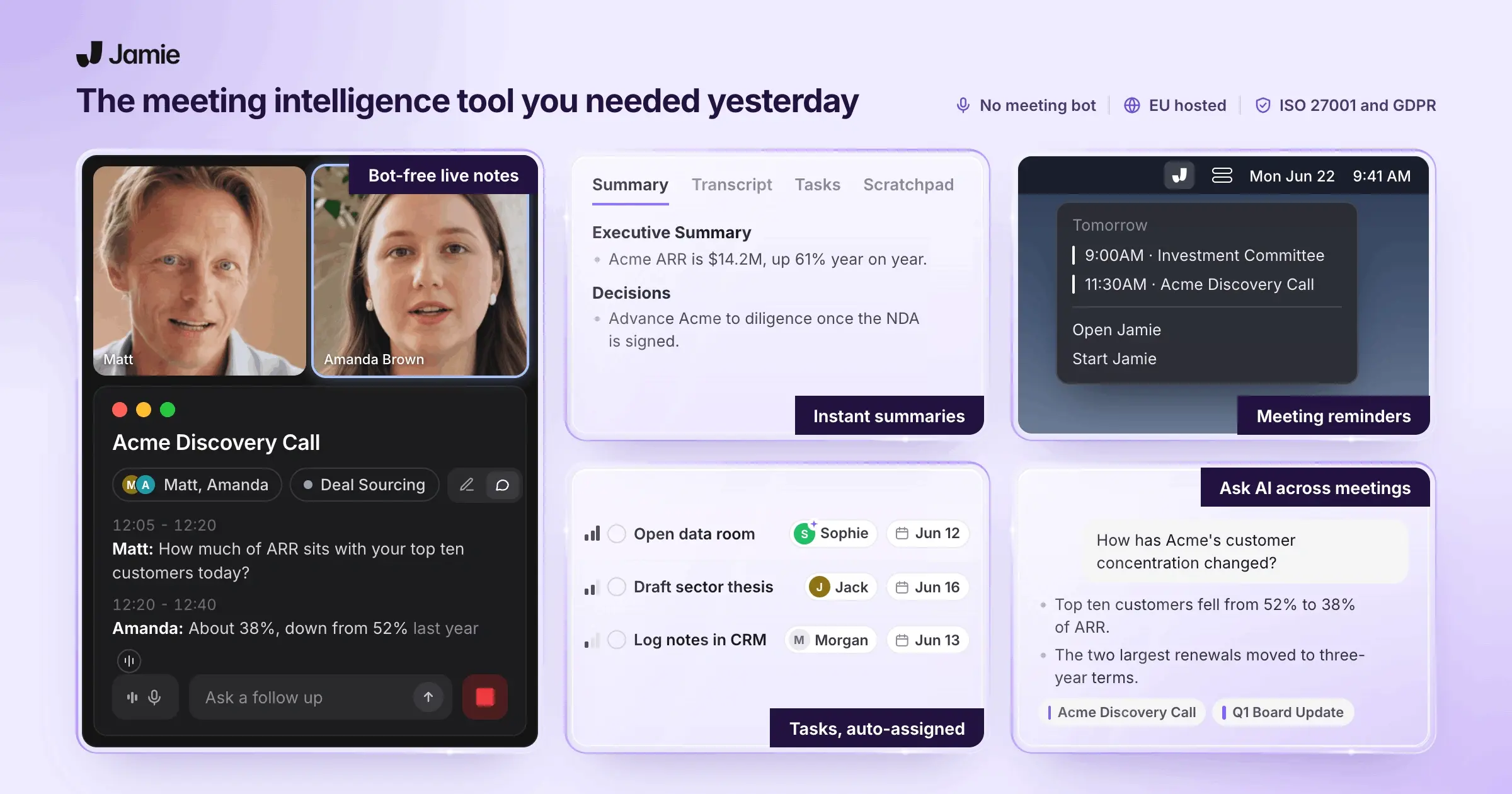
Jamie captures management meetings, expert calls, and deal discussions for private equity teams without visible bots that could hurt relationships. It transcribes conversations directly on your device, generates structured summaries with decisions and action items, and works across all platforms so associates can focus on asking questions instead of frantically documenting every answer for their 40-page investment memos.
Full feature list at a glance:
Transcription, meeting notes, action items, editing, tagging
Speaker identification, speaker memory, calendar integration, automatic meeting titles, consent emails
Bot-free operation, cross-platform (macOS/Windows/iOS), works online/offline/in-person, 100+ languages, GDPR-compliant with AES encryption
CRM integrations (Salesforce, HubSpot, Attio, Asana, Notion, OneNote), webhooks, copy-paste compatibility
Ask AI, Scratch Pad, Templates, Search across meetings
Who is it for?
Jamie is designed for professionals in high-trust fields like private equity who frequently conduct expert calls (e.g. on Zoom/Teams) and in-person meetings. It’s geared toward users who need clean transcripts, structured notes, and action items from meetings without altering their workflow (no special meeting bots or plugins required).
Stop Losing Critical Details From Management Calls
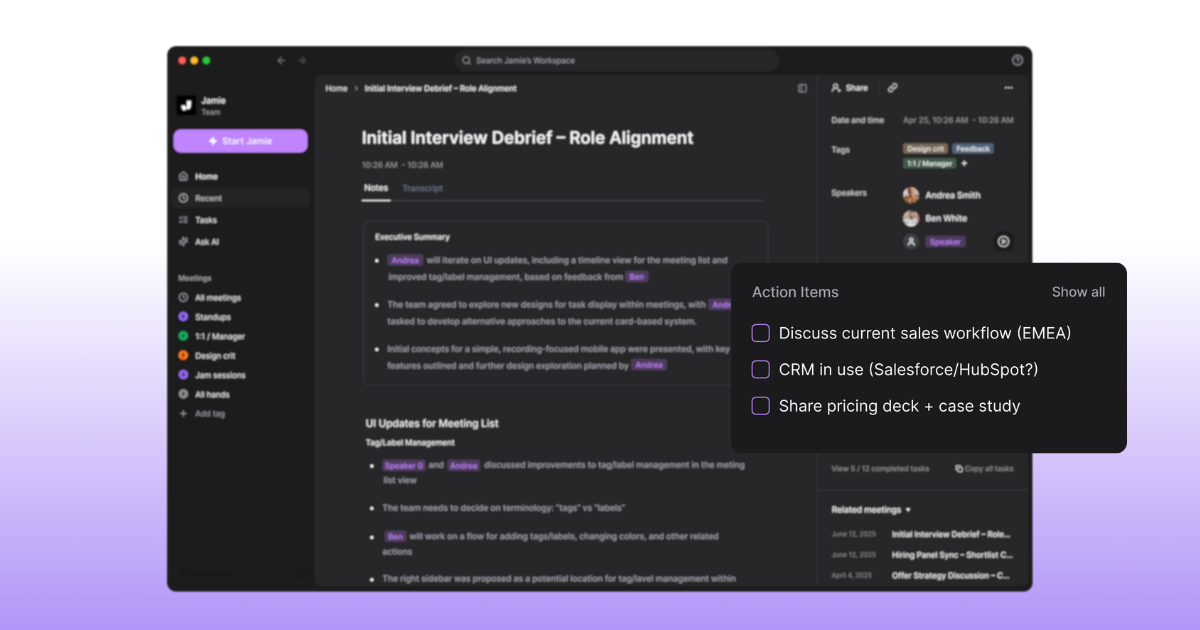
Deal teams juggling due diligence calls, expert interviews, and management presentations can't afford to miss key financial assumptions or strategic insights that IC will grill them on. Jamie automatically captures full transcripts, extracts decisions and risks, and organises talking points into sections you can copy directly into your memo.
Transcription: Captures every word from management team calls, so memo writers never guess on revenue projections
Meeting notes: Generates AI summaries organised by topic so associates find thesis points fast when drafting
Action items: Lists follow-up due diligence tasks automatically, so deal teams track what IC requested
Editing: Lets you fix company names or financial terms before sharing with senior partners
Tagging: Labels calls by deal name, so you filter 30 conversations down to target company discussions
Know Who Said What in Multi-Party Diligence Calls
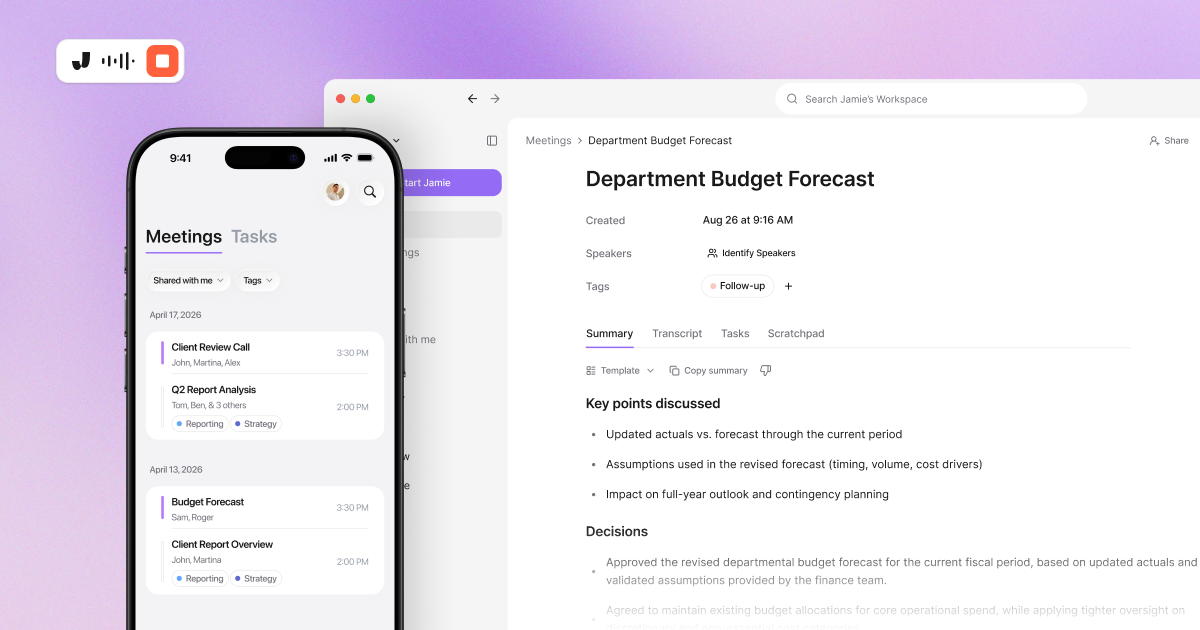
Associates on diligence calls with management teams, advisors, and consultants need to attribute statements correctly when partners challenge assumptions in IC. Jamie identifies each speaker and remembers their names across calls, sends consent confirmations, and syncs with calendars to prep context before each conversation.
Speaker identification: Labels CEO vs CFO statements automatically so memos cite the right executive accurately
Speaker memory: Remembers voices from past meetings so analysts don't re-label recurring participants each call
Calendar integration: Pulls meeting titles from Google or Outlook so deal teams get context-ready recordings
Automatic meeting titles: Generates descriptive names for unscheduled calls so you find specific discussions without guessing
Consent emails: Send automatic 24-hour advance notifications to calendar attendees so everyone knows recording is happening
Capture Confidential Calls Without Alerting Participants
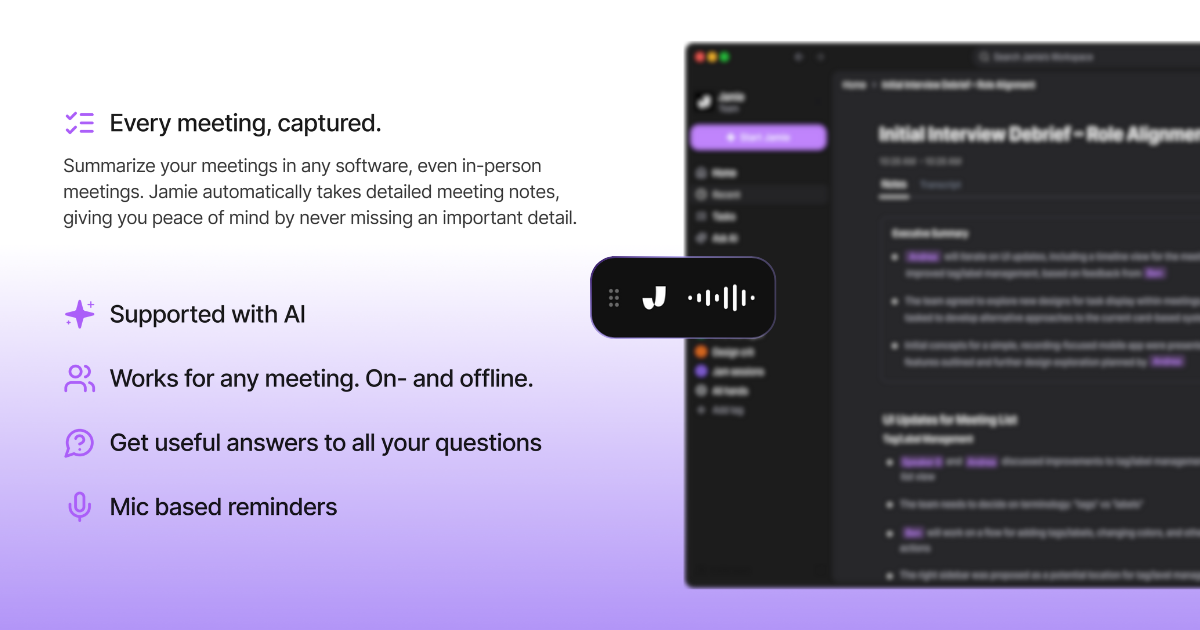
PE firms conducting sensitive management meetings or competitive landscape discussions can't have visible recording bots that make sellers uncomfortable or violate NDAs. Jamie records from your device without joining as a participant, works offline during onsite visits, and stores encrypted data on EU servers.
Bot-free operation: Records without visible bot participants so management teams stay comfortable during sensitive diligence discussions
Cross-platform compatibility: Works on macOS, Windows, and iOS so associates capture notes whether at desk or traveling
Offline/online flexibility: Records in-person facility tours or remote Zoom calls so teams document every interaction type
100+ language support: Transcribes multilingual management teams so cross-border deals get accurate documentation regardless of language spoken
GDPR compliance with AES encryption: Meets European data protection standards so firms satisfy compliance requirements for confidential deal information
iOS mobile app: Lets junior team members record impromptu management calls from their phones during site visits
Push Deal Intelligence Into Your Workflow
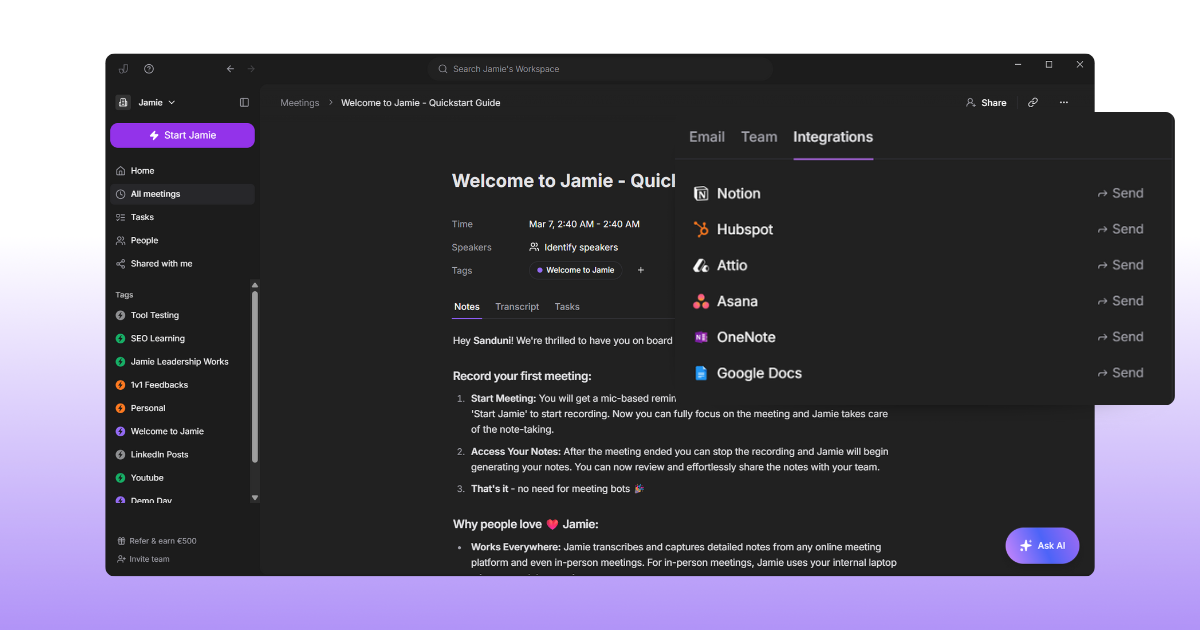
Associates building investment memos need meeting insights flowing into the tools where they draft analysis and track tasks. Jamie syncs structured notes into Salesforce for pipeline tracking, Notion for collaborative memo writing, Asana for diligence workstreams, and supports webhooks for custom automations.
Salesforce integration: Pushes summaries as notes to leads, opportunities, contacts, or accounts so the deal pipeline stays current
HubSpot integration: Syncs meeting notes to contacts, deals, or companies so investor relations tracks LP touchpoints
Attio integration: Sends summaries to person or company records as notes so teams using Attio CRM can centralise documentation
Notion integration: Auto-syncs or manually sends notes to Jamie's database so associates can paste findings into memo drafts
OneNote integration: Exports to My Jamie Notes notebook so Microsoft users can access summaries in a familiar workspace
Asana integration: Pushes tasks into selected projects with a summary PDF attached so diligence workstreams track follow-ups automatically
Webhooks: Let admins trigger custom automations via Zapier or Make when new meetings are complete for advanced workflow integration
Copy-paste compatibility: Preserves formatting when copying to Linear, Todoist, Bear, Typora, and Ulysses so content transfers cleanly
Find Past Discussions and Generate Insights
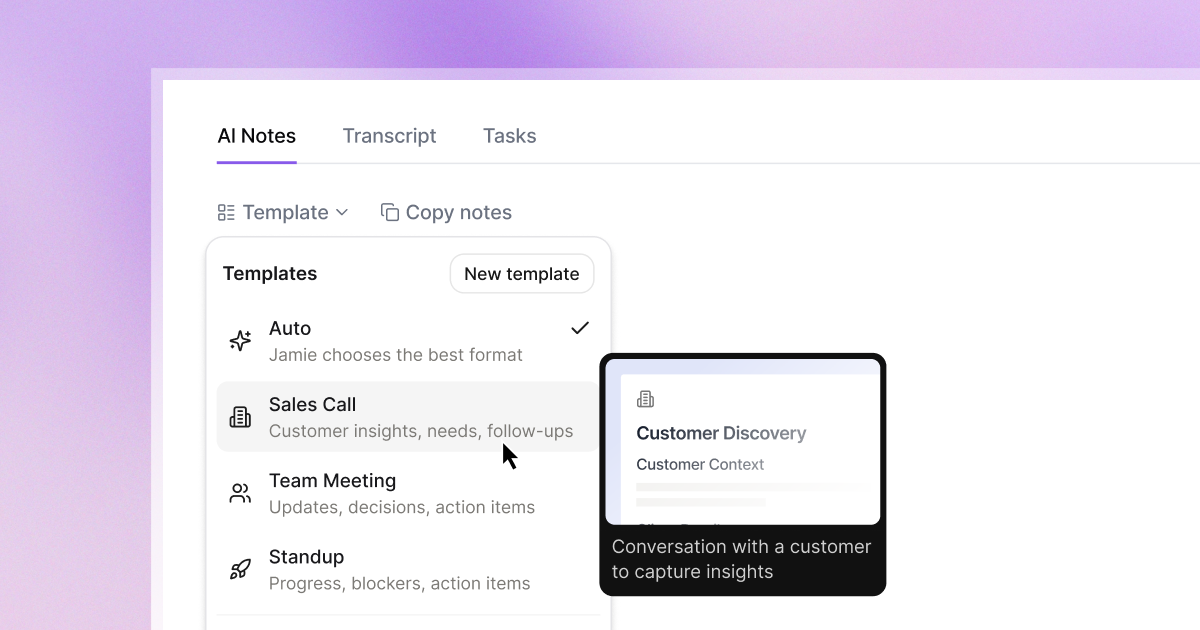
Deal teams reviewing months of expert calls and management updates for final IC memos need to locate specific statements and synthesise patterns. Jamie's AI features let you search across conversations, ask questions about what was discussed, capture live thoughts, and structure notes with templates.
Ask AI: Queries across all meetings or specific timeframes, so you can find CFO working capital comments across ten calls
Scratch Pad: Built-in notepad during meetings so you can jot down follow-ups or observations without switching apps, and everything stays attached
Templates: Structures meeting notes consistently with custom sections so management interviews capture the same diligence questions every time, and auto-apply picks the best format
Search across meetings: Filters by tags and timeframes so teams review only Target Co-tagged discussions when drafting thesis
Pricing
Free: €0 per month
Plus: €25 per month
Pro: €47 per month
Team: €39 per user/month
Enterprise: Contact sales (no monthly option; billed annually)
Pros and Cons
Pros
"I tried a dozen AI tools for meeting note taking. Most of them were crap, except one: Jamie"
"After researching and downloading different tools to generate meeting summaries, I decided to keep only this one. Why? Because it can transcribe, summarize, and detect action items with way more accuracy than the rest."
"I really appreciate Jamie for its simplicity and standalone functionality. It's incredibly easy to use without the need to join conferencing meetings or video calls."
"Jamie is the first tool I've tried that doesn't [require a bot]. It captures your notes without appearing as a meeting guest, handles both online and offline conversations." -
"Saved me a lot of time. Surprisingly also performed well in meetings with multiple languages (Japanese and English) used."
Source: G2, Product Hunt (Julia Hollnagel), MakeUseOf, LinkedIn (Tim Schumacher)
Cons
"I think overall the Ask AI feature can still be improved a little bit and the amount of integrations."
"The speaker identification feature of Jamie, though very useful, isn't entirely reliable or infallible. In our experience, to get the most effective results from Jamie, it was necessary to invest in a good quality microphone."
"There a few buggy things and missing integrations but Jaime is young and I have full confidence in what their future looks like. It's better than every other app I've tried, and I can guarantee you that I've deep researched and checked out a million.."
"Slow Note Generation: Processing can take several minutes, which may delay access to critical information in real time."
"Jamie's features are outstanding, sometimes I had the feeling that my audio quality heavily impacts the outcomes, which I need to adapt from my side."
Source: G2
Hebbia
Best for: Institutional finance teams (asset managers, investment banks, etc.) that need to search and analyze large document sets for research, diligence, and memo drafting
Similar to: AlphaSense, OpenAI’s ChatGPT, S&P Global Kensho
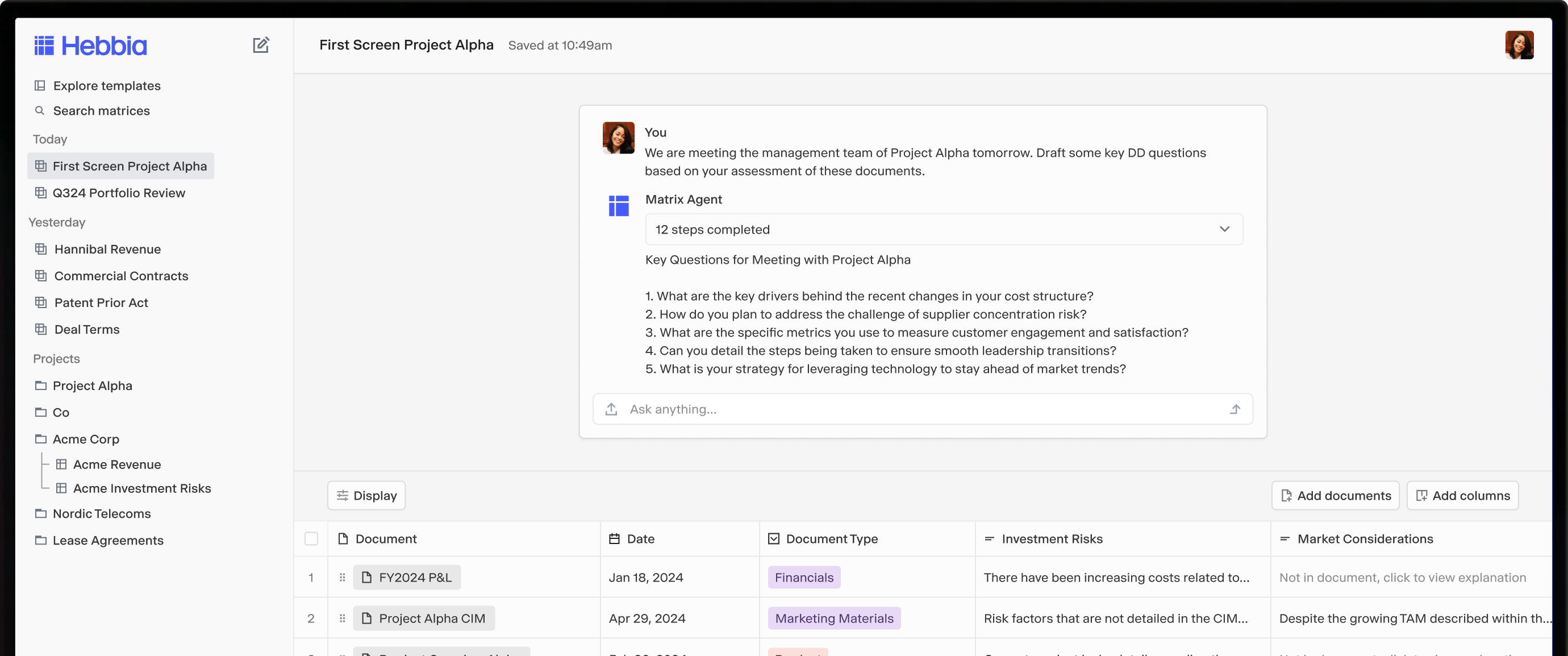
Hebbia is an enterprise AI platform built specifically for financial analysis and research. It acts like an “AI analyst,” allowing you to upload huge collections of filings, transcripts, and other documents and query them in natural language.
Hebbia uses a multi-agent system to break complex research questions into steps, providing fully cited answers and even generating financial models or memo drafts from unstructured text.
It includes an extensive content library (public and internal data) and an advanced search that understands industry terminology, all with enterprise-grade security and compliance.
Here’s an overview of its target users, core features, and more.
Who is it for?
Hebbia is aimed at financial professionals across asset management, private equity, investment banking, and consulting. It’s used by teams who handle intensive document reviews, like due diligence analysts and research associates – to quickly extract insights from thousands of pages of filings, transcripts, reports, and data room documents. In short, it’s built for analysts who need to turn mountains of unstructured financial data into actionable knowledge.
Key Features
Deep Document Understanding: Synthesizes insights from massive collections of PDFs, transcripts, spreadsheets, and more, returning answers with linked sources for auditability
Multi-Agent Workflows: Uses AI “agents” to tackle complex queries in steps, enabling tasks like diligence Q&A, multi-doc comparisons, and model building to be handled automatically with verifiable outputs
Transparent Reasoning: Every answer includes the AI’s step-by-step reasoning and exact source citations, giving users full transparency and defensible results for high-stakes finance decisions
Generative Outputs: Auto-generates financial models, comparison tables, and draft memos/presentations from unstructured text, converting raw data into client-ready deliverables
Enterprise Security: Offers zero data retention, encryption of data in transit and at rest, isolated data environments, and compliance with institutional standards (e.g. SOC 2, GDPR) for safe deployment
Pricing
Not publicly listed (enterprise / “book a demo” pricing).
Pros and Cons
Pros
The Matrix feature lets you extract structured info from multiple documents using customizable templates.
Hebbia helps you quickly extract key facts from large volumes of data with context-aware search.
You can convert PDF tables into Excel, which is useful for cash flows and rent rolls.
It's effective at navigating large folder systems and recognizes industry-specific terminology.
Offers flexible AI tools including cognitive search, chatdocs, and matrix in a single platform.
Cons
File and folder organization is unintuitive, especially when managing multiple projects.
Variations in document format can cause the Matrix feature to pull incorrect data.
Lacks ability to export Matrix outputs or answers directly to Word or PDF.
Chat history isn't saved, and basic functions like copy/paste aren’t clearly available.
No current integration with platforms like SharePoint; files must be uploaded manually.
Source: G2
AlphaSense
Best for: Financial analysts, researchers, and corporate teams who need to instantly search and synthesize market intelligence from vast data sources (filings, transcripts, research, etc.)
Similar to: S&P Capital IQ, FactSet, Bloomberg Terminal
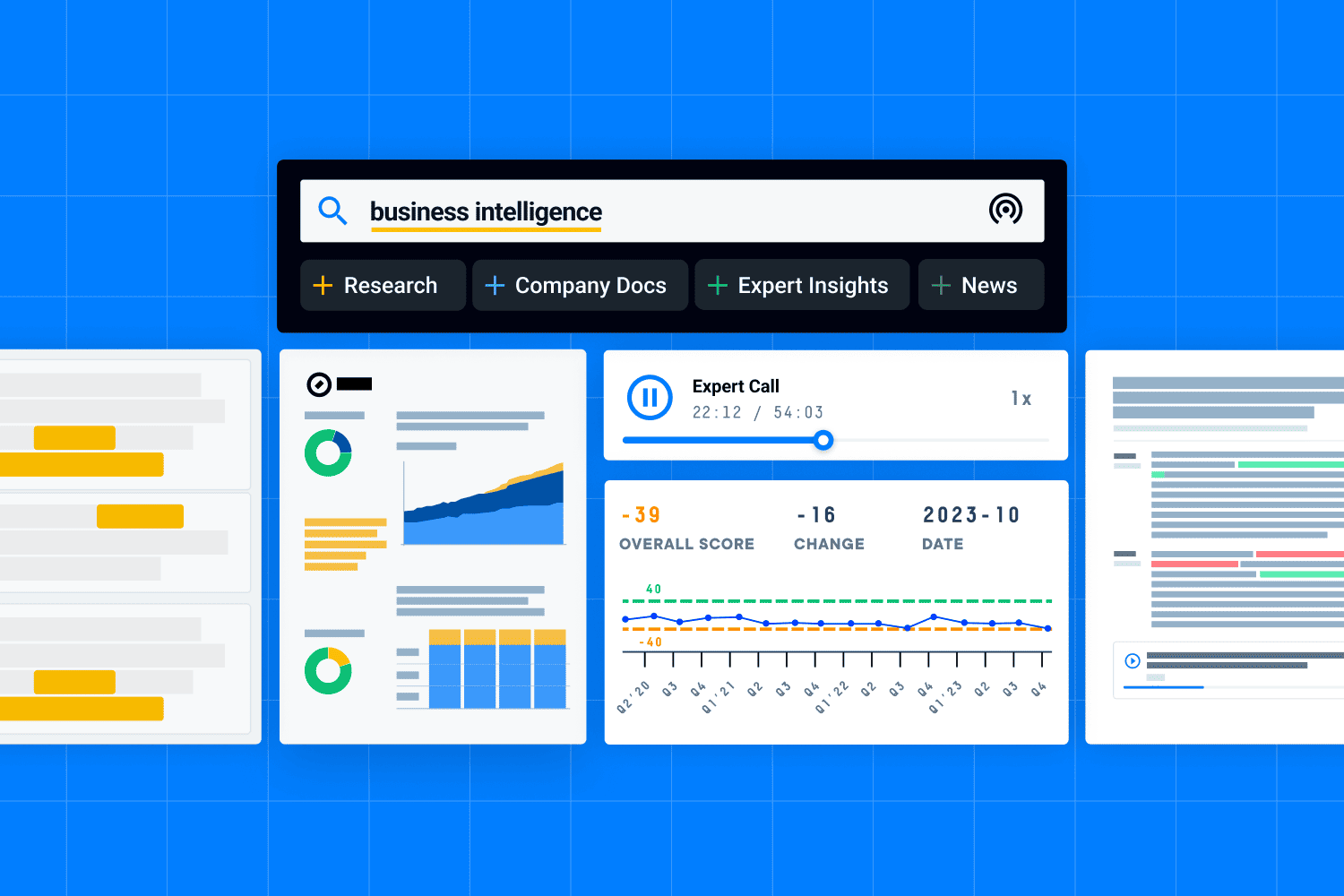
AlphaSense is a market intelligence and AI search platform for business and finance. It connects over 500 million premium documents, including SEC filings, earnings call transcripts, expert research, news, and even your internal files – into one searchable system.
AlphaSense’s AI understands industry terminology and context, delivering analyst-level answers with sentence-level citations instead of just keyword hits.
It also features generative AI “Deep Research” agents that compile comprehensive reports or comparisons across multiple sources, plus built-in financial data (models, screening tools, dashboards) for quantitative analysis.
Below, we outline its user base, key features, and more details.
Who is it for?
AlphaSense is built for professionals in investment banking, hedge funds, private equity, asset management, and corporate strategy roles. It’s typically used by anyone who needs to do fast, thorough research – for example, finding insights on companies or sectors across broker research, regulatory filings, news, and internal documents. In short, it serves finance and business teams that require a one-stop platform for informed decision-making.
Key Features
Unified Content Library: Indexes 500M+ external sources (company filings, investor transcripts, broker reports, etc.) and lets you integrate your own internal documents, all searchable in one place
AI-Powered Search: “Generative Search” understands natural finance language and synonyms, providing fully cited answers from relevant documents (no generic web results) in seconds
Deep Research Agent: An AI agent that acts like a virtual analyst team – it autonomously compiles investment-grade briefings and comparisons by querying multiple documents and data sets at once
Integrated Financial Data: Offers built-in financials and analytics (pre-modeled financial statements, comparables, M&A data, etc.) with Excel integration, so you can screen companies and update models directly within the platform
Monitoring & Alerts: Custom dashboards and real-time alerts keep you updated on target companies, competitors, or themes – you can set watchlists and get notified of new filings, news, or market changes instantly
Pricing
Not publicly listed (annual subscription; pricing via sales).
Public estimate (third-party): median buyer reportedly pays ~$18,375/year (based on reported purchases).
Pros and Cons
Pros
Delivers consistently accurate and concise answers to complex queries.
Semantic search understands query intent, not just keywords, saving you time.
AI-powered summaries highlight key insights from filings, calls, and research.
Collaboration tools let you annotate, share notes, and align research across teams.
Offers intuitive market monitoring with alerts, tagging, and summarized AI answers.
Cons
The learning curve can be steep, especially for advanced features and setup.
Some results may require manual refinement or Boolean search to improve relevance.
Navigation and alert setup can feel noisy or unintuitive.
Exporting specific insights and customizing dashboards could be smoother.
No integration support; all document uploads and access must be done manually.
Source: G2
Rogo
Best for: Elite investment banks and private equity firms looking to automate deal-related analyses (comparable profiles, pitch materials, etc.) with a secure, custom AI solution
Similar to: Hebbia, AlphaSense
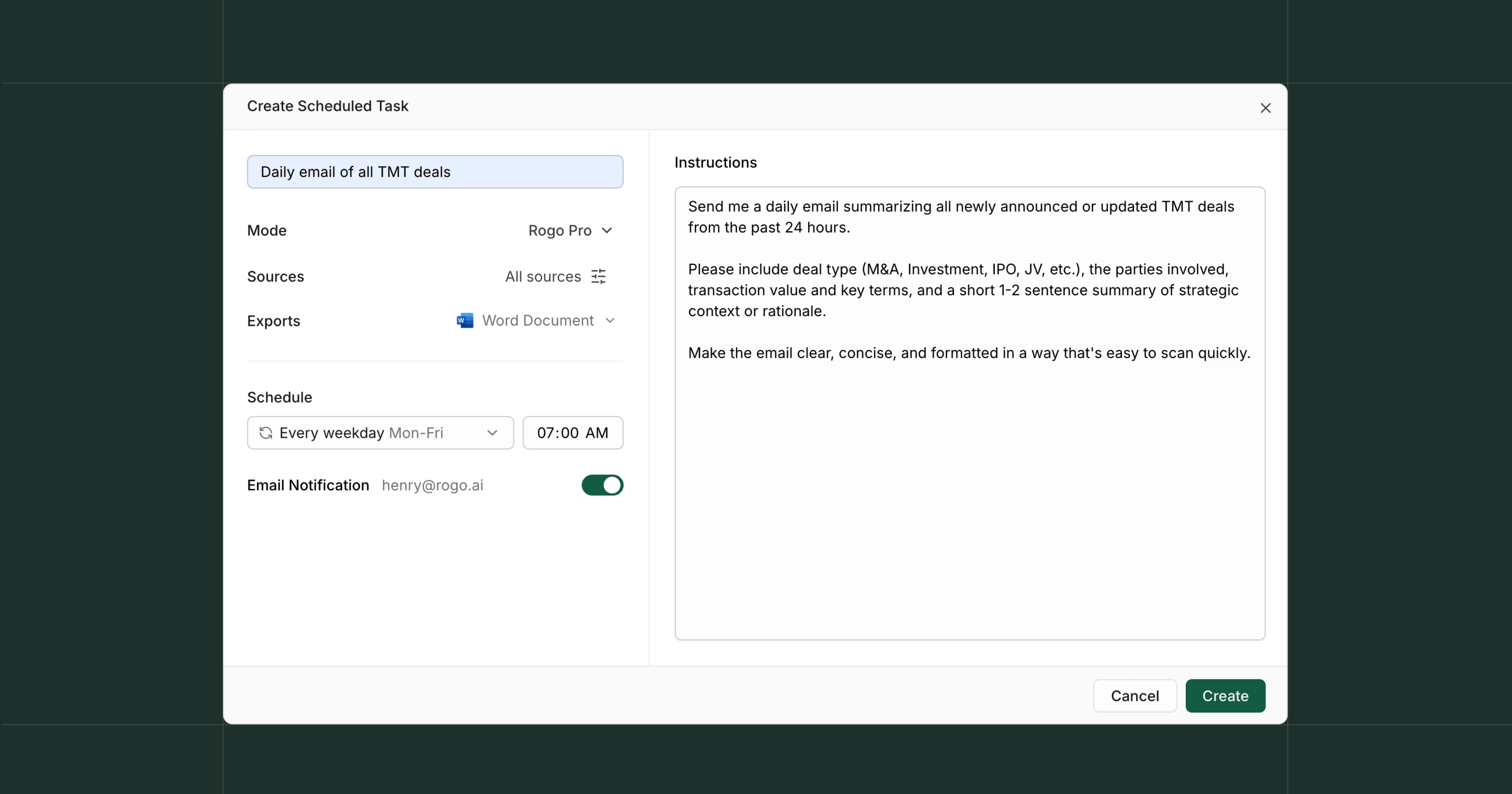
Rogo is a generative AI platform purpose-built for high-end finance workflows (think Wall Street deal teams). It integrates a firm’s internal data (models, decks, CRM notes) and external sources to produce accurate, audit-trail research and documents.
Rogo’s AI agents can automatically generate common deliverables – e.g. comparable company “strip” profiles, meeting prep memos, market updates, even draft pitchbook slides – in the same format an analyst would create them.
The platform is trained on finance-specific data by former bankers and investors, ensuring it “thinks” like a financial analyst and produces output to that standard.
We’ll break down who typically uses Rogo, its main features, and other key info below.
Who is it for?
Rogo is built for front-line finance professionals such as investment banking analysts/associates and private equity deal teams. It’s typically adopted by top-tier firms that handle large deal volumes and want to streamline research and document prep. Essentially, it serves as a “co-pilot” for bankers and PE investors, handling grunt work like comps analysis, company profiles, and drafting slides so they can focus on high-level strategy.
Key Features
Unified Data Research: Seamlessly connects to internal firm documents and external databases so it can pull information from all your sources at once, ensuring research is comprehensive and source-verifiable
Finance-Trained AI Model: Runs on a proprietary financial reasoning model trained by experienced bankers and investors, which means the AI understands deal context and uses industry-specific language accurately
Automated Deliverables: Provides pre-built AI agents to generate work products like Excel comp tables, PowerPoint profiles, meeting briefs, and other reports exactly in your firm’s format (e.g. ready-to-use pitch slides)
Custom Enterprise Deployment: Offers single-tenant installations and custom model tuning for each client – effectively letting firms embed their own data and workflow rules to get a competitive edge with AI
Robust Security & Compliance: Implements end-to-end encryption, granular role-based access controls, and meets enterprise security standards (SOC 2, ISO 27001, GDPR, etc.) to satisfy even the most sensitive finance IT policies
Pricing
Not publicly listed (quote-based / contract pricing).
Pros and Cons
Pros
Cuts down time for financial analysis and document creation from days to minutes.
Processes massive volumes of internal and external data to deliver quick insights.
Offers deep customisation to fit specific workflows in financial institutions.
Purpose-built AI models understand complex financial language and context.
Secure API and custom integrations allow seamless fit with existing tools.
Cons
Primarily built for finance, so it's less useful in non-financial industries.
Initial setup and system integration can be complex and time-consuming.
Smaller teams may find full implementation difficult to justify functionally.
Advanced features may take time to learn and fully apply within workflows.
May require ongoing adjustments to fit evolving internal data structures.
Source: Futurepedia
Hudson Labs Co-Analyst
Best for: Institutional equity investors (hedge funds, asset managers, family offices) who need rapid, precise analysis of public company filings, earnings calls, and financial disclosures
Similar to: AlphaSense, Bloomberg Terminal
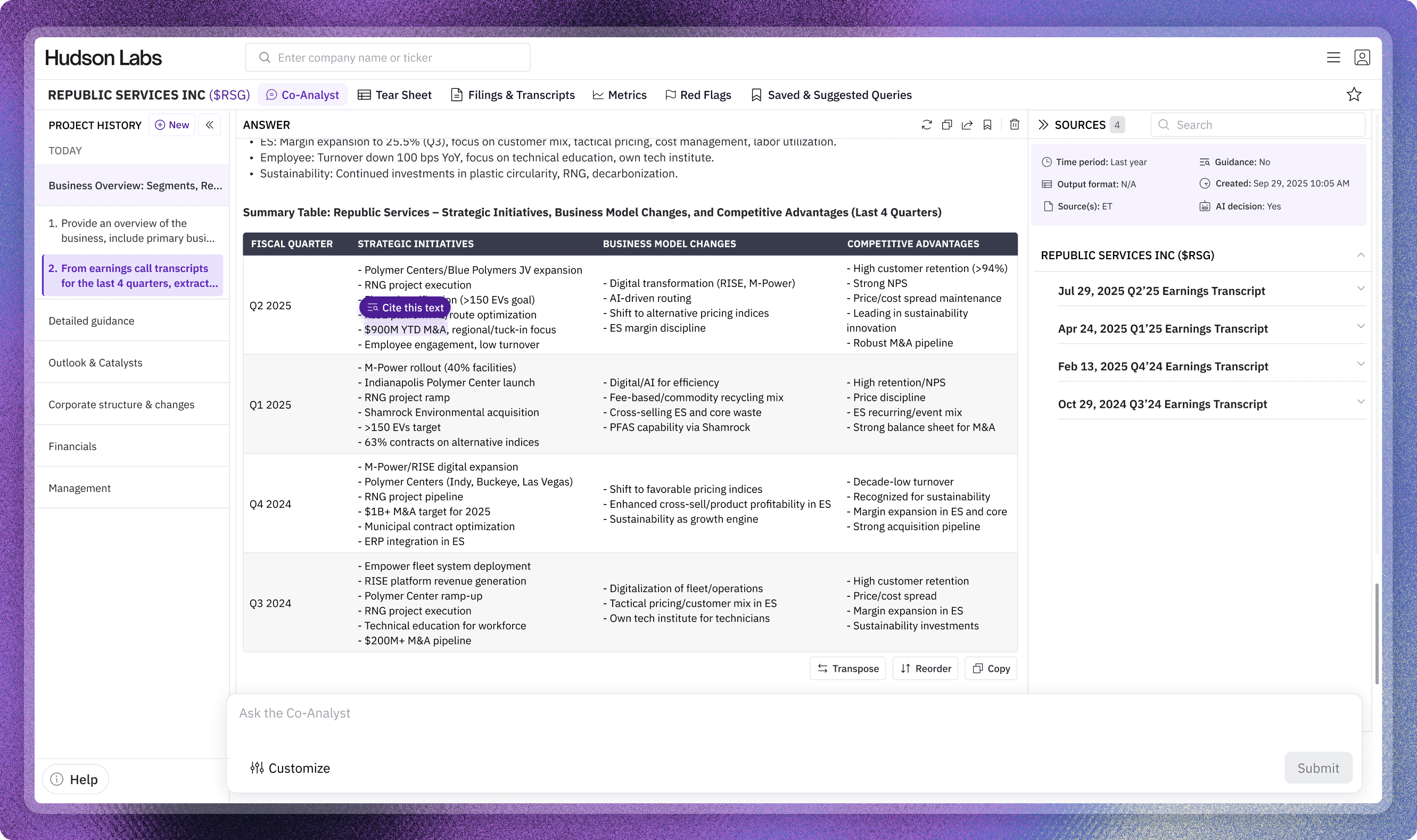
Hudson Labs Co-Analyst is a high-precision AI platform designed as a “co-analyst” for institutional finance research. It ingests multiple sources like SEC filings, press releases, investor decks, and transcripts, then answers your questions with “terminal-grade” accuracy – essentially providing Bloomberg-level data retrieval with AI’s flexibility.
Every result is source-verified and delivered as factual snippets or tables: the Co-Analyst pulls the exact figures or management quotes from the documents and presents them side-by-side, without paraphrasing or hallucinations.
The interface is simple: you ask in plain English and get precise, audit-trailed answers in seconds (no complex prompt engineering needed).
Let’s detail who uses Co-Analyst, its standout features, and more.
Who is it for?
The Co-Analyst is built for fundamental investors and analysts who demand very accurate data from public markets. Typical users are hedge fund analysts, portfolio managers at asset management firms, and research teams at large family offices or pensions – essentially, anyone who reads 10-Ks, earnings call transcripts, and investor presentations for a living. It’s particularly useful for those who track multiple companies and need to glean key metrics and management commentary quickly, with total confidence in the sourcing.
Key Features
Multi-Document Analysis: Scans and synthesizes information across all relevant documents (financial filings, transcripts, press releases, etc.) to answer queries with one cohesive, source-backed output
Source-Verified Answers: Provides only direct facts and figures from the original documents – every number or quote in an answer is pulled straight from filings or transcripts and comes with a citation, ensuring full transparency
Management Commentary Linking: Automatically links quantitative data with related management statements. For example, it will pair a revenue growth figure with the CEO’s quote explaining it, capturing forward-looking guidance and context side-by-side
Natural Language Queries: No complicated prompt needed – you can ask questions in plain English (“Show the last 5 years of capex and any management comments on capex plans”) and the system will retrieve and tabulate the answer directly from the documents
Terminal-Grade Accuracy: Employs finance-specific retrieval techniques, custom LLMs, and noise reduction to achieve the level of precision and numerical reliability that institutional investors expect (catching subtle changes in guidance, ensuring no important line is missed)
Pricing
Core: $100/month (individual tier)
Institutional: custom pricing
Pros and Cons
Pros
Gives source-linked facts so you can easily trace numbers or quotes back to filings or transcripts.
Handles multi-document, multi-period analysis for comparing commentary across quarters or peers.
Focuses on extracting and organising guidance, including nuanced forward-looking context.
Supports automations like earnings summaries and scheduled research updates.
Speeds up manual data extraction from filings and transcripts for public equity workflows.
Cons
Designed specifically for equity-research use cases, so it's less flexible for general-purpose tasks.
Geared toward public-company docs, so private-company analysis may need workflow adaptation.
Lacks built-in support for private-equity materials like CIMs or data room content.
Full feature access typically requires an institutional agreement and sales process.
An entry-level plan may cap queries or features, which could be limiting for frequent use.
Final Verdict: What Is the Best AI Tool for Private Equity Investment Memos?
The best AI tools for private equity investment memos are Jamie, Hebbia, and AlphaSense, and if you're building IC memos from management calls and expert interviews, Jamie is absolutely where you want to be.
You have to understand that investment committees don't care about your AI stack; they mostly care about whether your thesis holds up under scrutiny.
Jamie solves the fundamental problem PE deal teams face:
capturing accurate and
attributable intelligence from confidential conversations without the friction of visible recording bots that make management teams uncomfortable.
It transcribes directly from your device, remembers who said what across multiple calls, and generates structured summaries with decisions and risks so you can pull exact CFO statements on working capital or revenue projections straight into your memo without hunting through hours of audio.
Plus, the GDPR-compliant encryption and consent workflow mean you're covered when handling sensitive deal discussions, and the CRM integrations push meeting intelligence into Salesforce or Notion where you're actually drafting your analysis, so you're not copying and pasting across five different tools.
Hebbia is worth a look if you're primarily analysing complex financial data and unstructured documents like CIMs and data room filings; it handles multi-document synthesis really well with transparent source citations. AlphaSense works great for comprehensive market research when you need to search across 500M+ external sources, including broker research, earnings transcripts, and regulatory filings, alongside your internal documents.
Quick Recap of the Best AI Tools for Private Equity Investment Memos
Jamie: Keeps your confidential management calls and expert interviews natural by recording from your device without visible bots, which honestly changes everything for PE diligence. You get speaker-labelled transcripts with action items and key decisions that flow directly into your investment memo while maintaining the trust sellers expect. Plus, the AI search lets you query across months of calls to find that specific CFO comment about customer concentration when IC starts drilling into your assumptions!
AlphaSense: Delivers powerful semantic search across massive content libraries, great for institutional teams who need integrated access to broker research, filings, and market intelligence with AI-powered summaries.
Hebbia: Excels at deep document understanding with multi-agent workflows, perfect for analysing huge data room collections and generating financial models from unstructured text with full source citations.
Hudson Labs Co-Analyst: Provides terminal-grade accuracy for public equity research, ideal for fundamental investors who need precise figures and management commentary from SEC filings and earnings calls.
Rogo: Built specifically for elite investment banks and PE firms with automated deliverable generation, works well if you need custom AI trained on your firm's internal deal data and formats.
When you're comparing artificial intelligence platforms for professional investment memos, most PE teams find that capturing accurate management call insights and maintaining data security matters way more in day-to-day use than having access to every possible external data source.
The firms automating routine tasks like investment memo generation see the biggest productivity gains when they start with the conversations that actually inform their thesis, expert calls, management interviews, and operating partner discussions, because that's where the differentiated insights live.
Plus, when you're evaluating complex financial data across the investment lifecycle, being able to search your own call archive and extract key components like financial performance validation, company overview details from management, and competitor analysis from industry experts becomes incredibly valuable during IC prep!
Howeverrrr... If you're considering Jamie, you can download it for free on desktop or get the iOS app!
We know how much it matters to have tools that actually help you get things done while keeping your privacy intact. That's why we truly recommend giving Jamie a try, risk-free.
You're welcome to book a free demo if you'd like to see it in action first. We're always here to support you on your journey to better, simpler meetings and note-taking.
Read More
Explore our guide to AI note-taking tools for private equity firms and how they support IC memo creation.
Learn how venture capital teams use note-takers to streamline founder calls.
See how Wenvest Capital leverages AI meeting tools in diligence workflows.
Discover the top AI-powered note-takers for financial teams, driving memo-ready outputs.
Understand how consultants are capturing insights with AI note-taking platforms.
FAQs on AI Tools for Private Equity Investment Memos
How do I capture management call insights for investment memos without bots disrupting the conversation?
You can transcribe management meetings and expert calls while preserving natural conversation with Jamie, which operates from your device without adding a bot participant to the call, maintaining the trusted relationship sellers and portfolio companies expect while generating accurate transcripts with speaker identification, key decisions, and action items after you inform participants you're capturing notes. Deal teams juggling multiple diligence workstreams get complete records of financial projections, competitive positioning, and strategic rationale without the friction of visible recording technology, while alternatives like Fireflies.ai work well if you're comfortable with bot-based workflows in less formal internal meetings.
What's the fastest way to get expert call notes into my 40-page IC memo without rewriting everything?
You can pull structured meeting notes directly into your investment memo with Jamie's AI summaries, which automatically organise management statements by topic like market trends, competitive advantage, and key risks, so you can copy relevant sections straight into your thesis, risks, or market position analysis without manually sorting through hours of transcription. Your memo drafting accelerates from days to hours because the heavy lifting of extracting investment thesis points, financial projections validation, and operational improvement opportunities happens automatically, while platforms like AlphaSense excel if you need comprehensive market research reports alongside your call documentation.
How do I track which CFO or CEO said what across ten diligence calls when writing my IC memo?
You can attribute executive statements accurately with Jamie's speaker identification and speaker memory, which labels each participant automatically and remembers voices across multiple calls, so when your investment committee challenges a revenue projection or customer concentration claim, you cite exactly which management team member made the statement and when. Associates building comprehensive investment memos avoid the nightmare of mis-attributing critical financial assumptions or strategic rationale, while tools like Hebbia provide deep document understanding if you're primarily analysing written diligence materials like CIMs and data room filings.
What's the best way to keep confidential portfolio company discussions secure and GDPR-compliant?
You can maintain strict data security for sensitive deal discussions with Jamie's GDPR-compliant infrastructure, which transcribes meetings locally on your device, stores encrypted transcripts on EU servers in Frankfurt, and permanently deletes audio files after processing while giving you full control over who accesses investment committee materials and portfolio company value creation plans. Private equity firms managing sensitive data across investment teams, operating partners, and limited partners stay compliant with European privacy standards without sacrificing the advanced AI tools needed for informed investment decisions, while platforms like Rogo offer custom enterprise deployment if you need firm-specific model tuning and single-tenant installations.
How do I search across months of management calls when partners ask specific questions during IC?
You can find exact statements from past conversations using Jamie's Ask AI and search features, which let you query across all tagged meetings or specific timeframes, so when investment committees drill into working capital assumptions, customer churn risks, or pricing power, you retrieve the relevant CFO comment from three calls ago without manually reviewing hours of transcripts. Deal teams preparing for investment committee grilling get instant access to supporting evidence for their investment thesis, key performance indicators validation, and risk assessment claims, while Hudson Labs Co-Analyst provides terminal-grade accuracy if you're primarily researching public company filings and earnings transcripts rather than internal management calls.
What AI tool helps with both diligence call notes and syncing insights to our deal pipeline CRM?
You can transcribe due diligence calls and automatically push structured notes into Salesforce, HubSpot, or Attio with Jamie's CRM integrations, which sync meeting summaries, action items, and key discussion points directly to opportunity records so your deal sourcing pipeline stays current without manual data entry while you focus on analysing market opportunities and assessing portfolio company value creation potential. Investment teams tracking multiple live deals get real-time intelligence flowing into the tools where they manage deal lifecycle workflows, while platforms like AlphaSense excel if you need integrated financial data and pre-modelled financial statements alongside your meeting documentation.
How do I structure interview notes consistently when evaluating management teams across different targets?
You can evaluate leadership capabilities consistently using Jamie's templates, which structure every management interview around the same operational, strategic, and financial questions so you can compare executives fairly across portfolio companies and document decision-making styles, growth strategies, and operational expertise in standardised formats that investment committees expect. Associates conducting commercial due diligence and management assessment get repeatable frameworks for capturing strategic rationale, competitive positioning, and value creation plans, while Rogo provides automated deliverables like comparable company profiles if you need standardised pitch materials and Excel comp tables.
What's the best way to capture onsite facility tour observations and offline management meetings?
You can document in-person site visits and offline meetings with Jamie's cross-platform support, which works on macOS, Windows, and iOS to record facility tours, management working sessions, and operational reviews, whether you're onsite at a manufacturing plant or in a conference room without internet access. Deal teams conducting operational due diligence and process validation get complete documentation of capacity constraints, quality metrics, and supply chain observations that inform investment risks assessment and post-acquisition improvement plans, while platforms like Hebbia handle massive document collections if you're primarily processing data room PDFs and financial filings rather than live conversations.
How do I extract value creation ideas from operating partner discussions for my memo's growth strategy section?
You can identify operational improvement opportunities by querying Jamie's Ask AI across calls with operating partners, portfolio company executives, and industry consultants, which surfaces recurring themes like pricing optimisation, cost reduction, or market expansion that become actionable value levers in your investment thesis and 100-day plan. Investment professionals building post-acquisition roadmaps get data-driven insights into portfolio management priorities, critical insights on margin improvement, and concrete next steps for transforming private equity portfolio companies from conversations that would otherwise live scattered across notebooks and memory.
What tool helps me prepare for IC questions by finding contradictions across management, consultants, and expert calls?
You can validate consistency across diligence sources by searching Jamie's meeting archive for specific topics like revenue growth drivers, customer acquisition costs, or competitive threats, which reveals whether management team projections align with what expert network calls, consultant QoE reports, and customer interviews actually show. Associates defending their investment recommendation against investment committee scrutiny get proactive identification of key risks, contradictory market data, and gaps in the deal thesis before partners surface them, while Hebbia's multi-agent workflows excel if you need AI to automatically compare claims across hundreds of written documents and generate risk matrices.