Product & Engineering
Product Scoping Template
Add this template to your Jamie account or sign up and try it.
Use template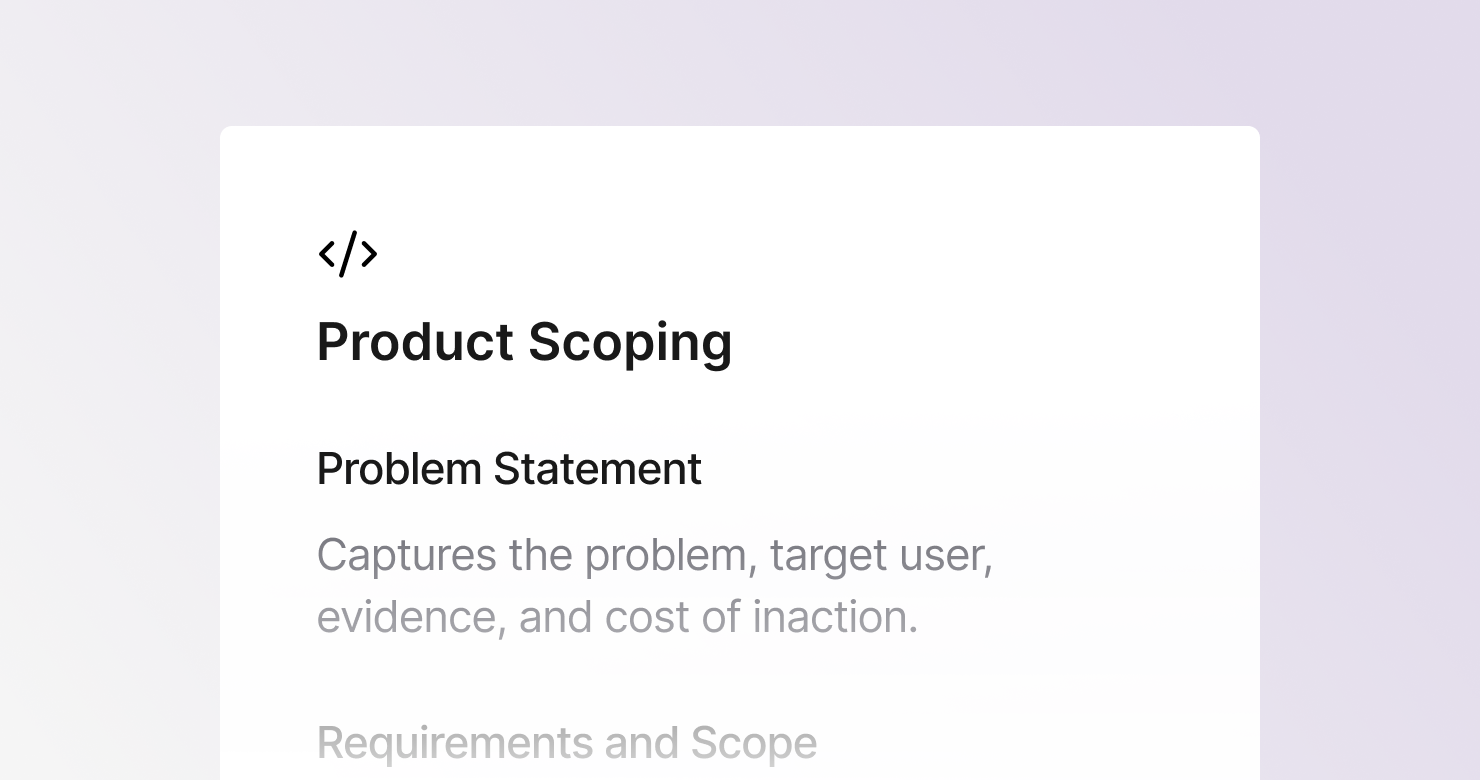
A product scoping template is a structured format for documenting product scoping sessions where teams define what to build, why, and how success will be measured. It captures the core problem being solved and who it affects, what is in scope and explicitly out of scope, user stories with acceptance criteria, technical decisions and trade-offs, success metrics, and open questions that need resolution before development begins. The goal is to produce notes clear enough that engineering can start work without guessing - and that product and design have a shared record of every decision made during scoping.
About this template
This template has six sections. Each one tells Jamie what to capture during a product scoping session and how to structure the output.
Section 1: Problem Statement
Captures what specific problem is being solved, who the target user is, the evidence that it is worth solving, and what happens if the team does not build it.
Section 2: Requirements and Scope
Documents what must be done, non-functional requirements, what is explicitly out of scope, and any constraints around timeline, budget, or technology.
Section 3: User Stories and Acceptance Criteria
Captures user stories in the standard format with acceptance criteria for each, edge cases discussed, and priority level.
Section 4: Technical Considerations
Captures architecture decisions, technical trade-offs and the chosen path, dependencies on other teams or systems, technical risks, and any spikes needed.
Section 5: Success Metrics
Defines how the team will know the work was successful: metrics tracked, target numbers, and whether an experiment is planned.
Section 6: Open Questions and Next Steps
Lists everything unresolved with owners and deadlines, deferred decisions, and the next milestone.
Why Teams Use This Template
Vague scoping creates expensive surprises in development
The most costly time to discover that a requirement was misunderstood is mid-sprint. A structured scoping note that documents what is in scope, what is out, and every open question that was resolved prevents those surprises.
Technical trade-offs that are not documented get relitigated
When the team decided to use approach A over approach B during scoping but the decision was never written down, the debate restarts three weeks later when a new engineer joins the work. A structured technical considerations section ends that loop.
Success metrics defined at scoping survive longer than success metrics defined at launch
When teams define what success looks like before they build, the metrics reflect the actual goal. When they are defined after, they tend to reflect whatever the numbers happen to show. A structured success metrics section makes the original intent permanent.
Scoping sessions involve the most cross-functional participants and the most decisions
Product, engineering, design, and sometimes data, security, and legal are all in a scoping session. Jamie captures the full conversation and structures it automatically, so the PM does not have to choose between participating in the discussion and taking notes.
How to Use This Template in Jamie
Jamie works natively on your device. No bot joins your call, no meeting link needed. Use it across every online platform, capture in-person meetings via your laptop or phone, and get structured notes in 100+ languages - and your data stays on EU servers, fully encrypted, GDPR compliant.
Step 1: Add the Product Scoping template in Jamie under Settings > Templates - or click Use this template to load it automatically.
Step 2: Start your scoping session on any platform: Zoom, Teams, Google Meet, or in person.
Step 3: Within minutes of the session ending, your notes appear structured in six sections.
Step 4: Switch templates after the fact if needed. Jamie regenerates the summary in the new format.
Built for product and engineering teams
Jamie processes and stores your data only within the EU. All data is encrypted with AES-256 in transit and at rest. No third-party bot sits in your call. Audio is streamed for transcription and never stored. The template works with any meeting platform and handles sessions in 100+ languages.
FAQS
A product scoping template should include six sections: the problem statement with evidence of why it is worth solving, requirements and explicit scope boundaries, user stories with acceptance criteria, technical considerations and trade-offs, success metrics defined before building starts, and open questions with owners and deadlines.
Scoping documentation needs to capture decisions, not just discussion - what was agreed, what was ruled out, and what is still open. Product teams use Jamie to apply a scoping template automatically, so structured notes covering all six areas are ready within minutes of the session ending.
Effective scope definition requires explicitly documenting what is out of scope as well as what is in. The Jamie Product Scoping template has a dedicated requirements and scope section that forces both sides of that line to be written down, reducing the scope creep that comes from ambiguity.
User stories captured during scoping should include the format, the acceptance criteria, edge cases discussed, and priority level. The Jamie Product Scoping template structures all four elements automatically from the conversation.
Yes. Jamie works natively on your device with no bot joining the call, so cross-functional scoping sessions stay focused on the problem rather than on the presence of a recording tool.